English Garden Tour: Garden Picture of the Day, A Cottage in Warninglid

A Cottage in Warninglid, Haywards Heath, Sussex
A Cottage in Warninglid, Haywards Heath, Sussex

I’ll Grow Anywhere, North Hall, Sheffield Green, UK
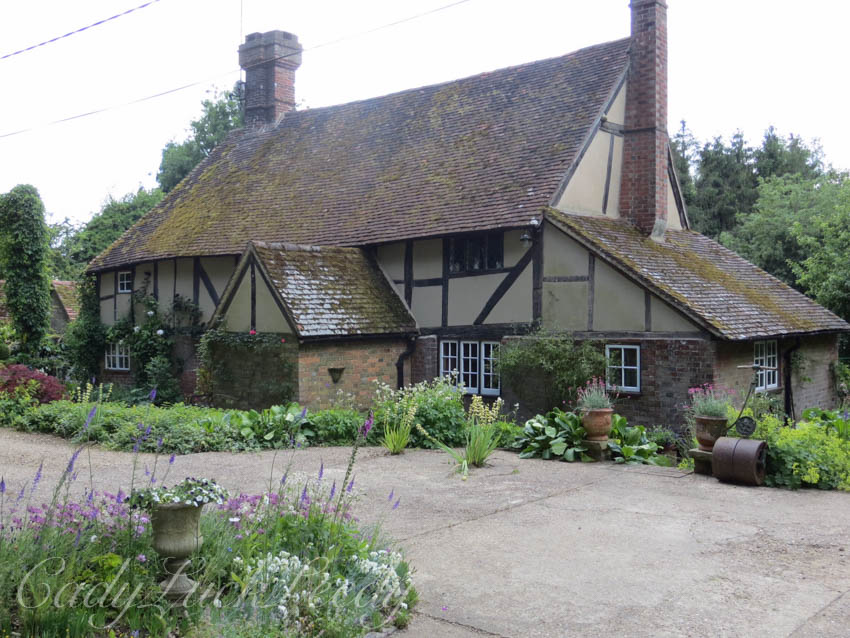
North Hall, Sheffield Green, Uckfield
Why just have a driveway, when you can have a garden in it?

North Hall, Sheffield Green, Uckfield
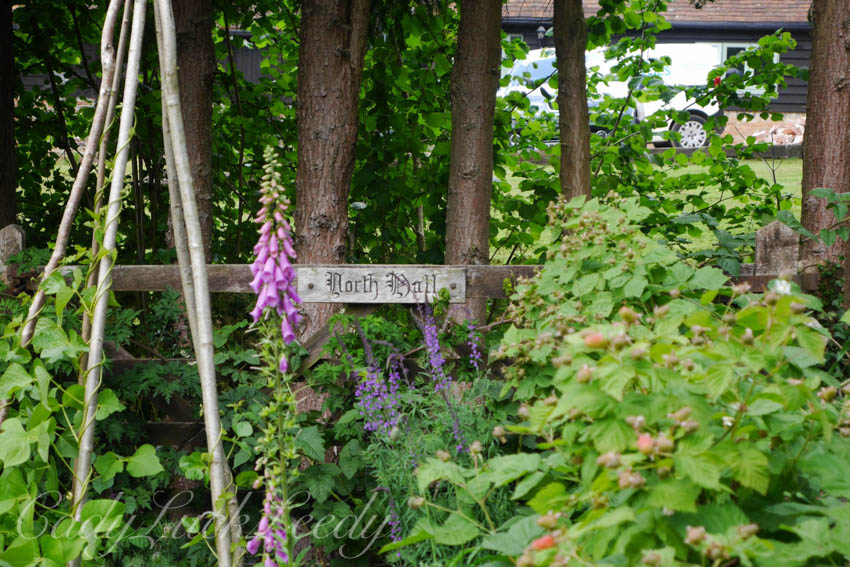
North Hall, Sheffield Green, Uckfield
Here it is, the house and garden of a woman’s dreams! From the moment we entered the drive and was directed to the meadow to park in, I couldn’t wait to see the gardens surrounding this beautiful home! For background musica there was a couple seated at a table playing old time favorites on old, old, crank record players.

The Music at North Hall, Sheffield Green, Uckfield
What sound! So crisp and clear! Who knew! No Beats headphones here! Next was the antique Rolls Royce to inspect. Setting the mood we entered the garden!

The Rolls Royce at North Hall, Sheffield Green, Uckfield
North Hall is overflowing with a palette of soft colors and heady scent. The garden is planted abundantly with a variety of plants. Pathways along the house show off antique planters and old garden equipment creating interest in the multiple tiers of the garden. There are themed island beds, moated terraces, and roses tumbling over the walls. On the back lawn is an area with tables covered in vintage lace cloths and antique table covers, set up for tea and cake. Let’s wonder through this garden shall we? I’m sure this will be one of your favorites on the National Garden Schemes too. This garden is very much loved!
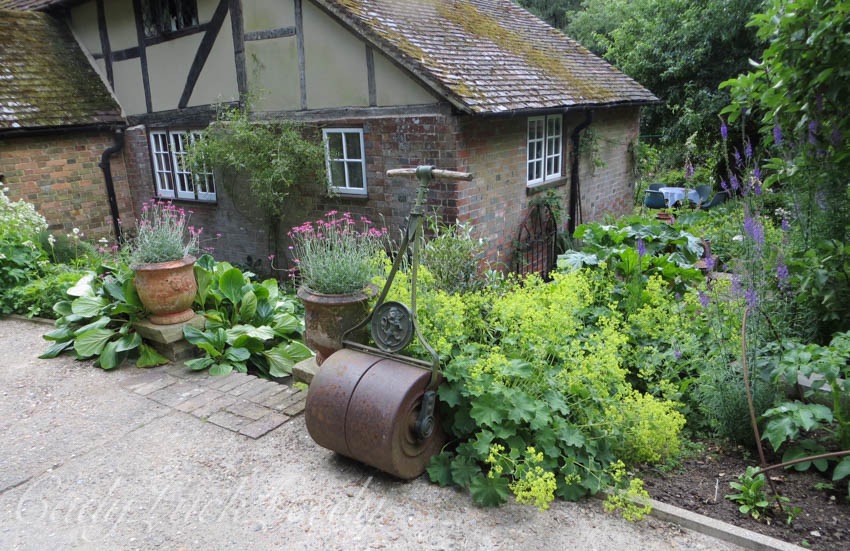
Entering the Path to the Garden at North Hall
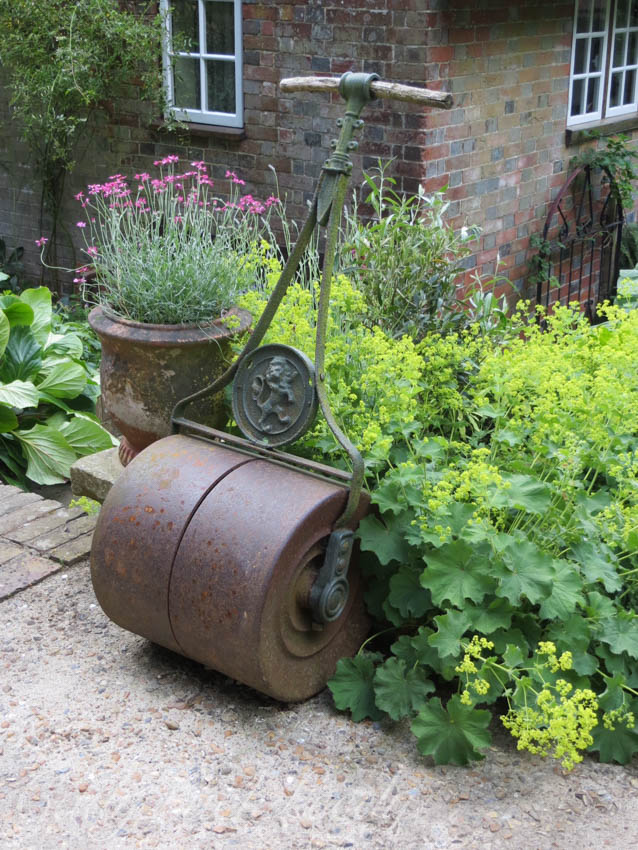
THE Lawn Roller at North Hall, Sheffield Green, Uckfield
Stepping down, the multi-tiered brick paths along the brick walls allowed you to see plants up close at eye level.
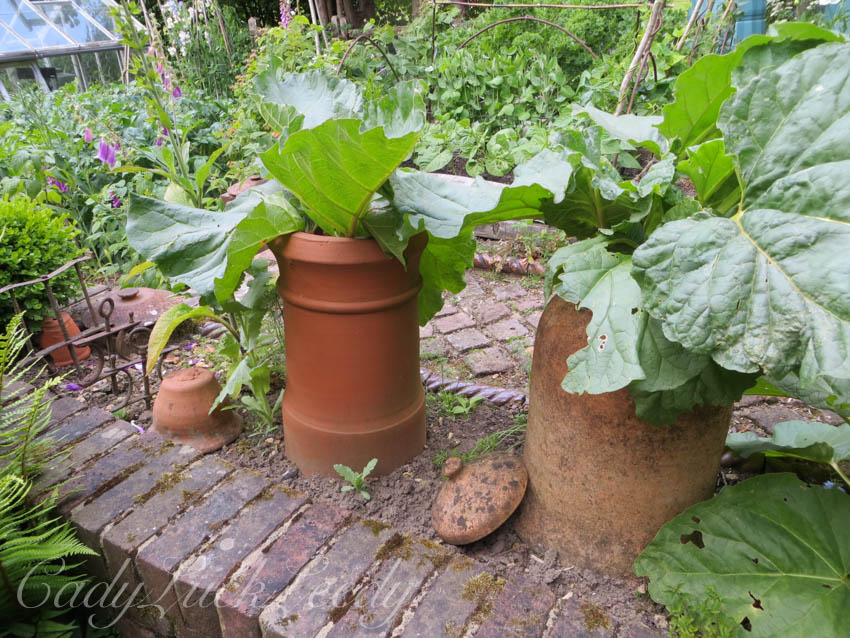
More Chimney Pots Used for Planters at North Hall

The Terraced Gardens at North Hall

The Garden at North Hall, Sheffield Green, Uckfield
The roses covered the house. Notice the contrast of the pinks and violets.

A Side Garden of North Hall, Sheffield Green, Uckfield
Four sides to the house gives one four different gardens!
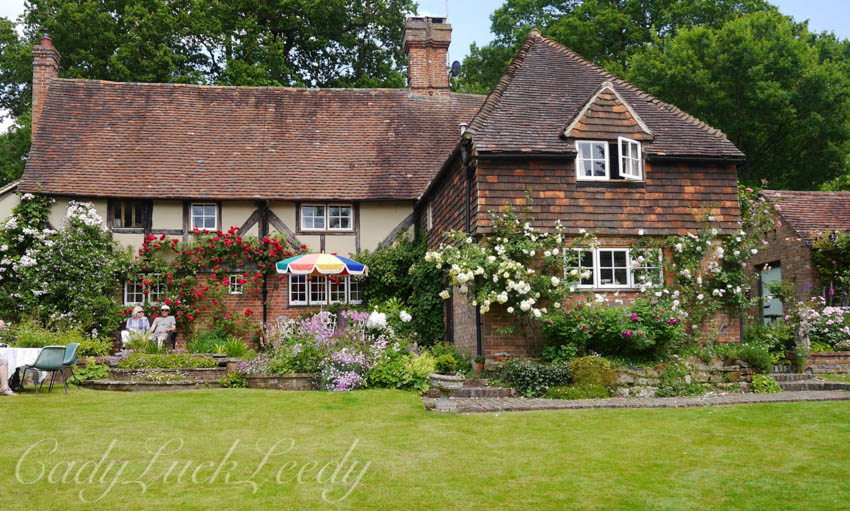
A Look from the Back of the Garden, North Hall
A delightful seating area, was surrounded by a garden moat! What an inspirational way to add a water garden!
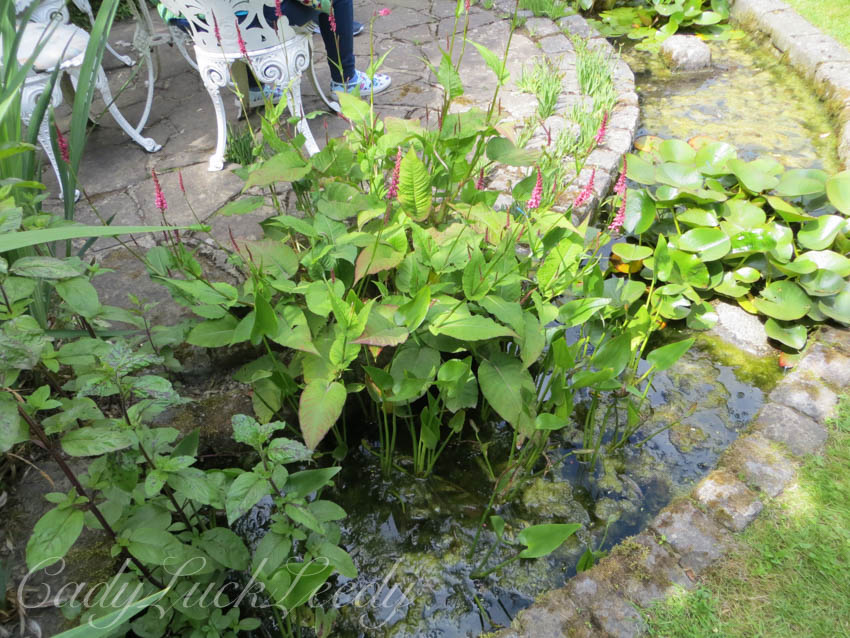
The Moated Terrace at North Hall
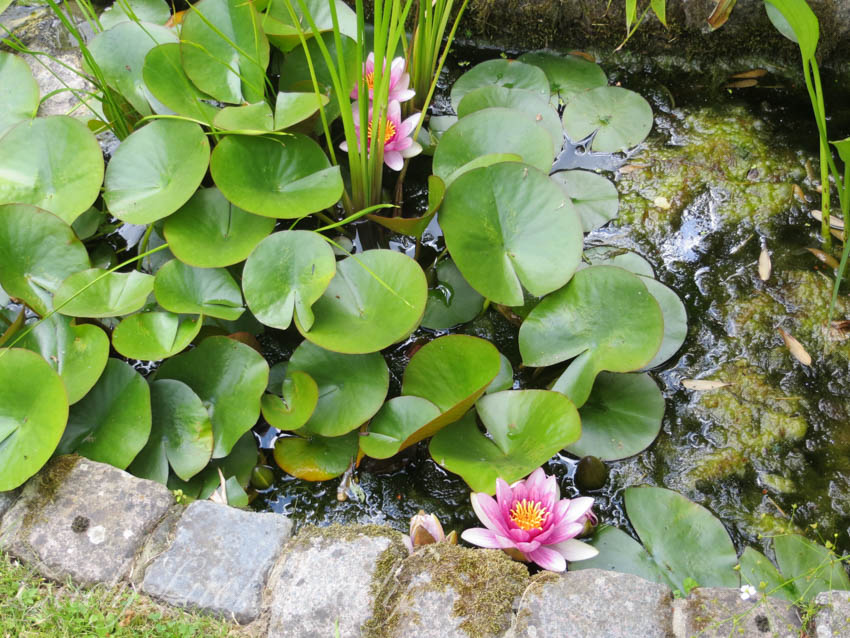
Water Lillies in the Moat at North Hall
There were garden rooms created for relaxing and meeting up with fellow gardeners!
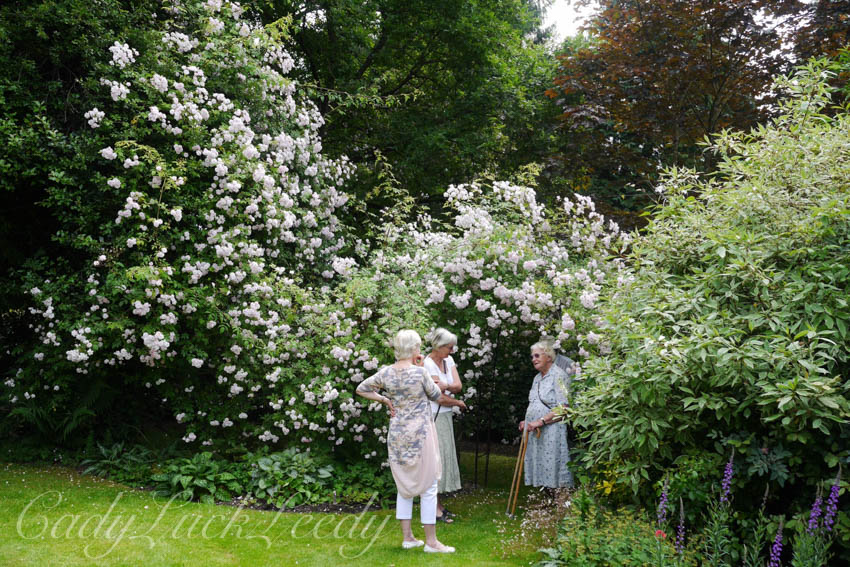
Real English Gardeners!

A Look at the Tea Sets, North Hall
I loved the contrast of the black and lime colors in the garden!
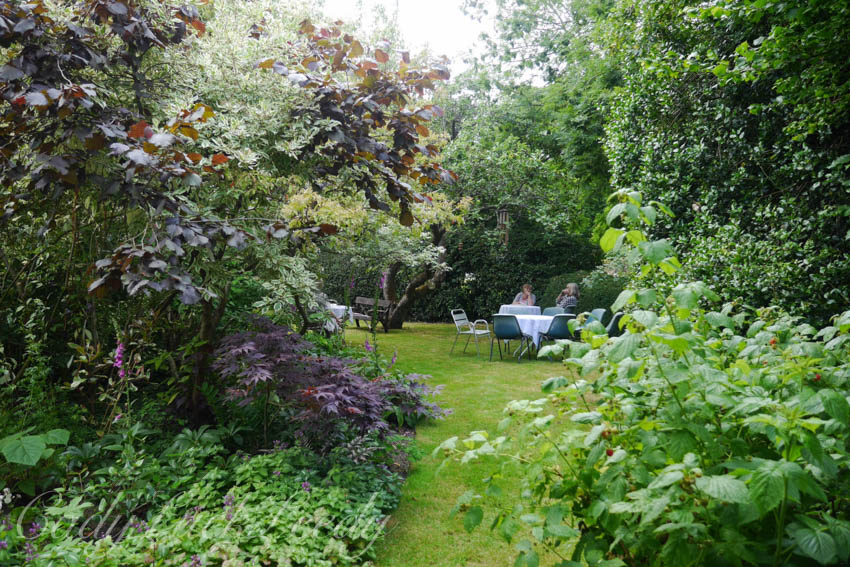
Tea Time in the Garden at North Hall
Entering another “Garden Room.”
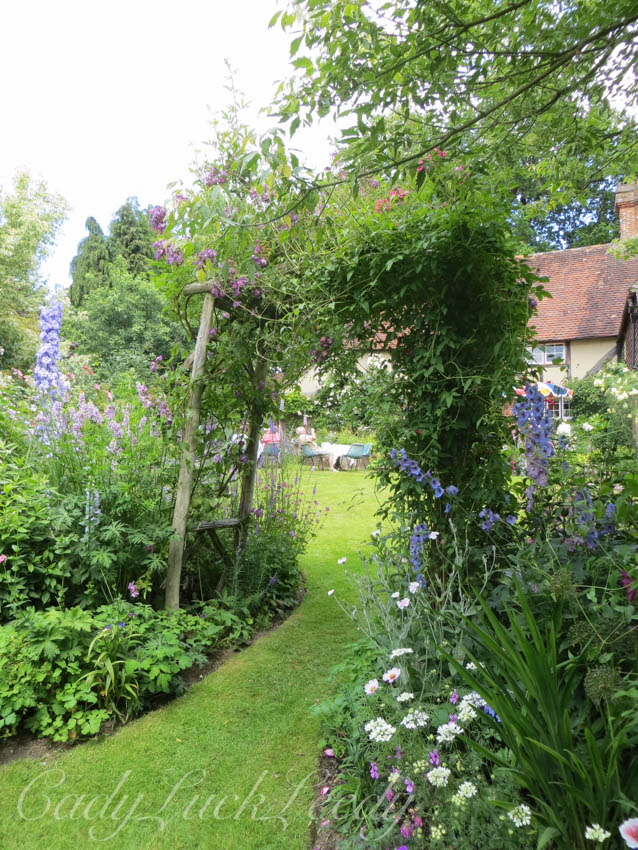
An Arbor at North Hall
Rainfall water storage and composting in the garden! Nothing was overlooked!

Garden Interest at North Hall

Garden Tools Adds Interest to the Clematis Garden at North Hall

The Flowers of North Hall
Trees and flora were tagged! How thoughtful!

Tree Tag at North Hall

The Flowers of North Hall
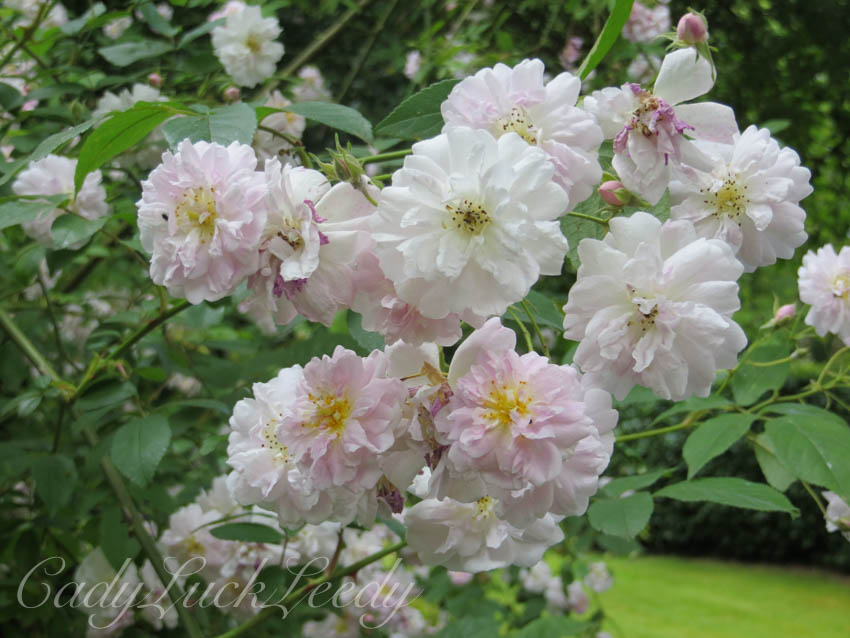
The Flowers of North Hall

The Flowers of North Hall
Add a spot or two!

The Flowers of North Hall, A Mixture in the Garden
Or maybe a bright PINK!

The Flowers of North Hall

The Flowers of North Hall
Can you believe the combination of lavender and blue? They were iridescent!
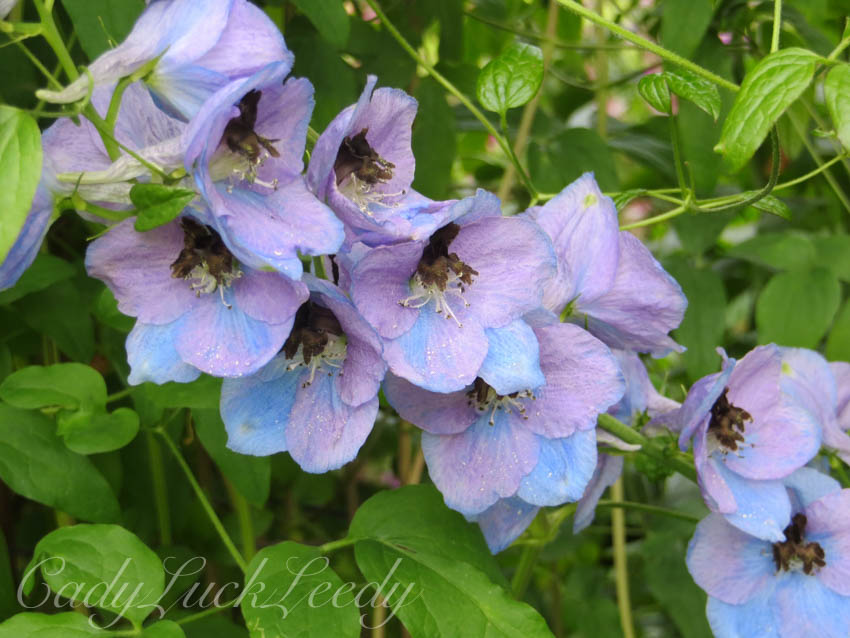
The Flowers of North Hall

The Flowers of North Hall

The Greenhouse at North Hall
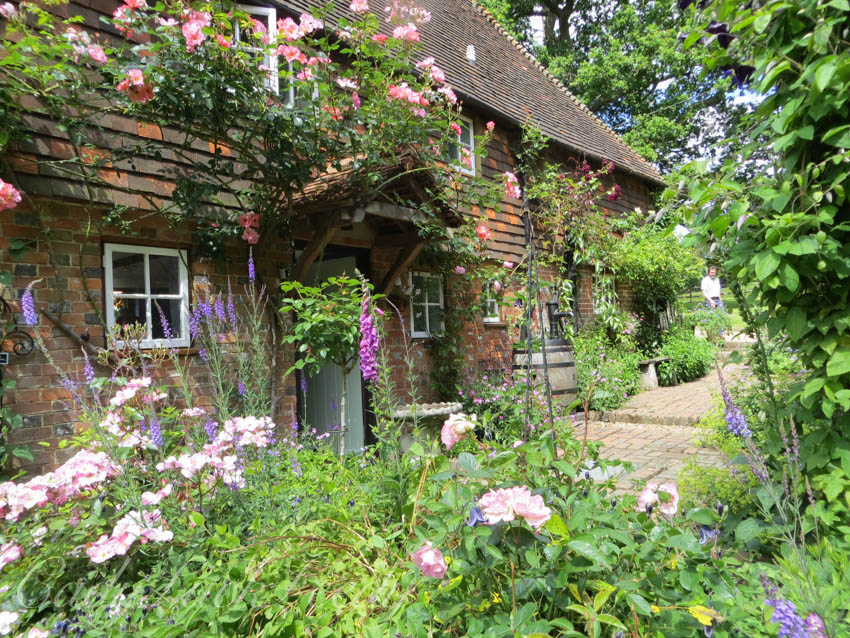
The Other Side of North Hall

The Topiaries at North Hall
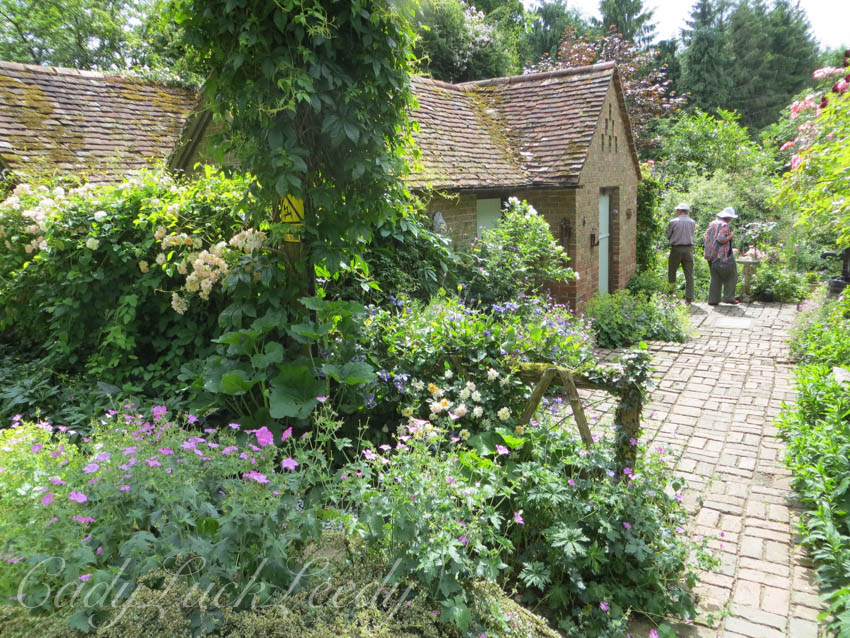
The Garden at North Hall, Sheffield Green, Uckfield
This is one garden I could visit over and over! I just loved it! Thank you, North Hall, for sharing your beauty with us!
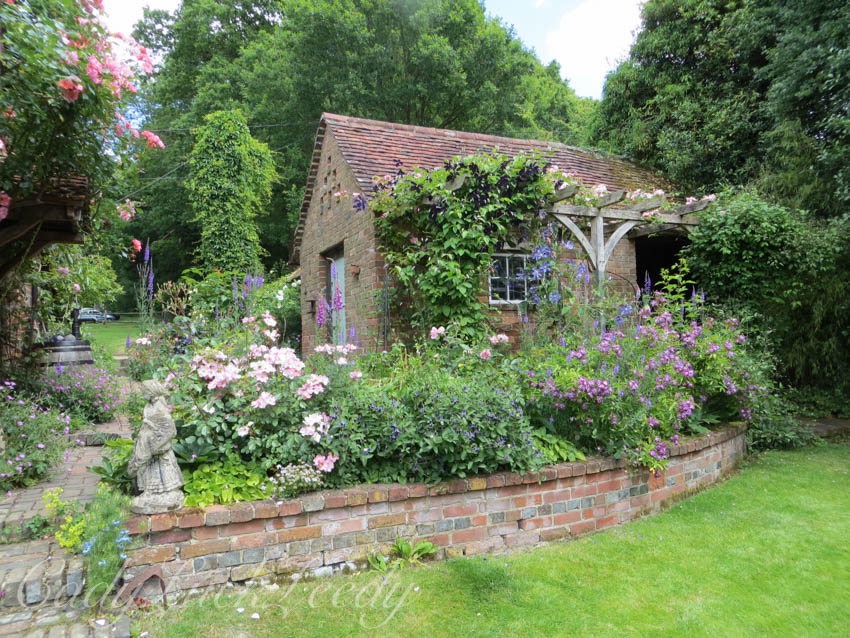
The Varied Terrace Gardens of North Hall
I have so many beautiful pictures from the gardens on the National Garden Scheme in the UK. I called my visit to the gardens, “The English Garden Tour.” Local gardeners open their gardens once a year for charity. Luctons, in Sussex, is a must see! Can’t you just imagine sitting at the end of the day in this garden? I can!

Luctons Garden on the National Garden Scheme, UK

The Church of St Andrew and St Mary the Virgin, Fletching, Uckfield

1 Whites Cottage, Fletching, Uckfield
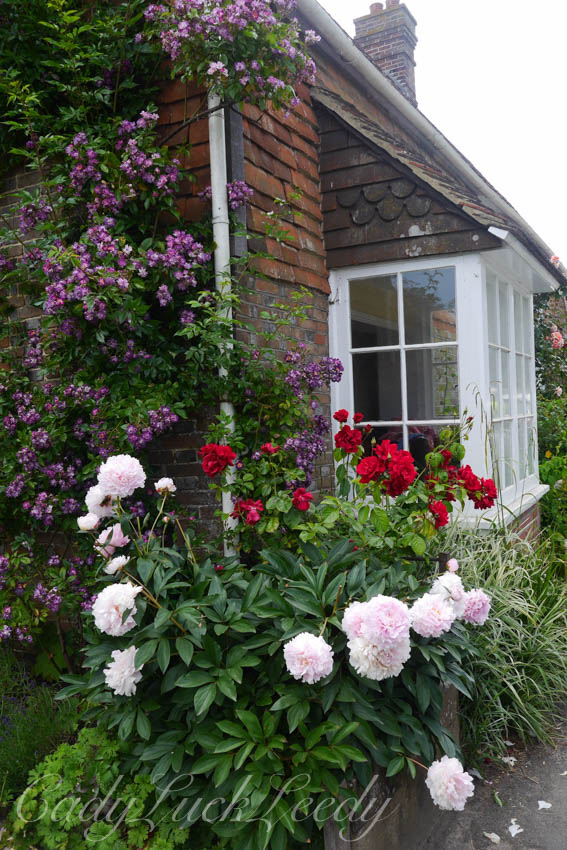
1 Whites Cottage, Fletching, Uckfield
Across the street from the Church of St Andrew and St Mary the Virgin, in the village of Fletching, is a row of tiny, clustered, connected cottages that look just like dollhouses. The garden at 1 Whites Cottage is compact, and exactly what you would think a cottage garden should look like. Following winding paths there are lovely groupings of flowers, delights for the child of any age, and riots of color, color, color in that messy, disheveled look imagined in fairy tales. What child could not spend the day in a gypsy caravan surrounded by a family of ducks? Snuggled in your perfect spot, this cottage is where stories are told. Let’s take a peek at Whites Cottage, one of the cottages on the National Garden Scheme.
The Rows of Small Cottages at Fletching, Uckfield

Beauty at the Whites Cottage, Fletching, Uckfield
And what is beyond the garden gate?

Beauty and Color at the Whites Cottage, Fletching, Uckfield

Masses of Soft White Blooms at Whites Cottage, Fletching, Uckfield
What’s behind here? Let’s look and see!
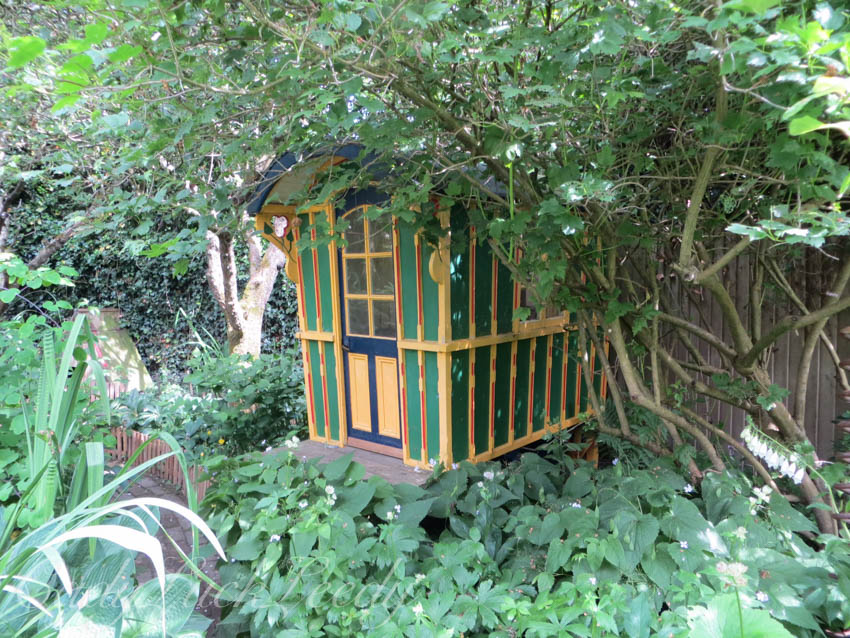
The Tiny Gypsy Caravan, Whites Cottage, Fletching, Uckfield

One of the Duck Family at Whites Cottage, Uckfield

The Duck Cottage at Whites Cottage, Fletching, Uckfield
Here was an area for the succulents! Some were planted in chimney pots! Waste not, want not! Where can I get one of those and how can I get it home? Hmmmm…..

Garden Interest at Whites Cottage
Bright colors in the garden!
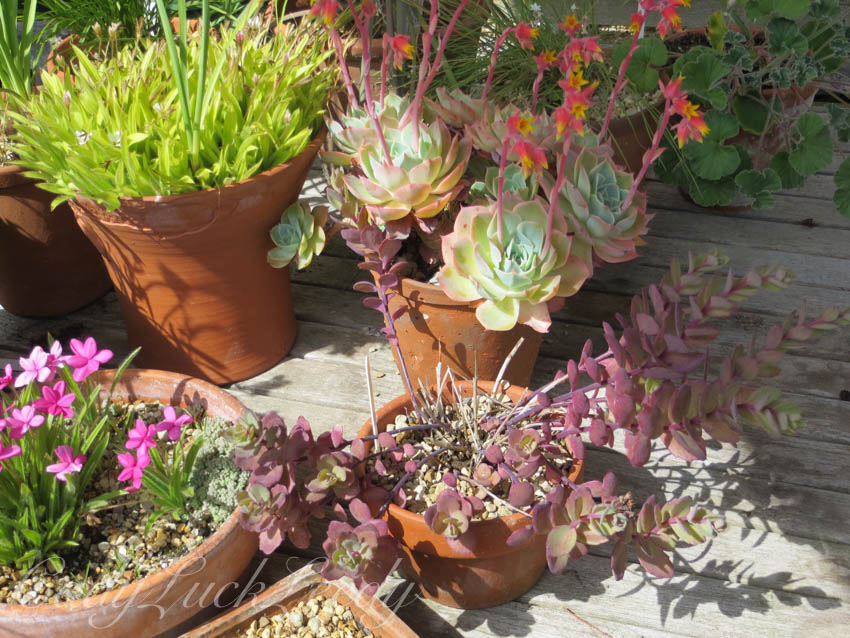
More Succulents at Whites Cottage, Fletching, Uckfield
The blooming clematis was so delicate and I loved the lime and lavender centers with the crisp, clean, green leaves!

The Beautiful Blooming Clematis at Whites Cottage, Fletching, Uckfield
What’s down this grassy knoll?
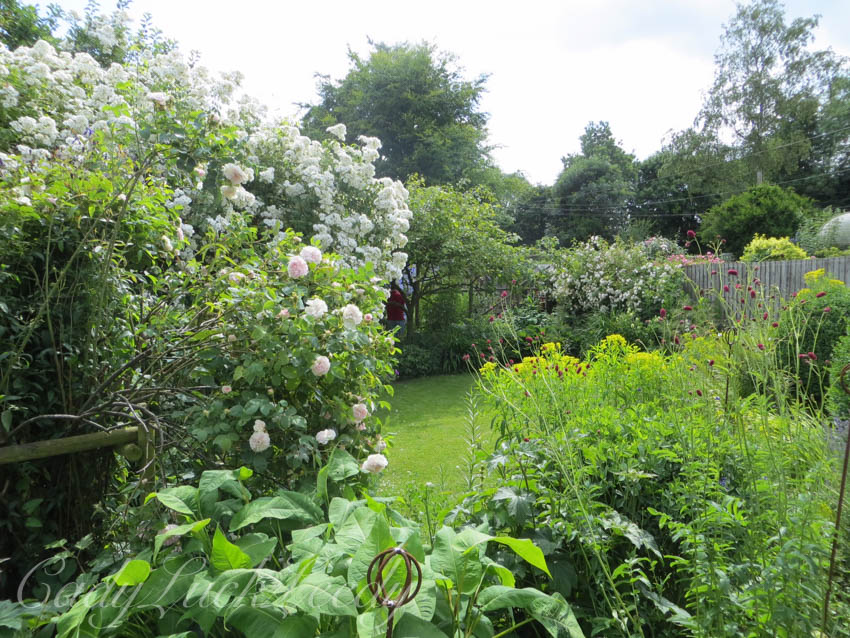
Another Look at the Garden, Whites Cottage, Fletching, Uckfield
I love the way you see the seeds in this plant!

The Vines at Whites Cottage, Fletching, Uckfield

The Greenhouse at Whites Cottage, Fletching, Uckfield
Art in the garden, look up, look down. We don’t want to miss anything!
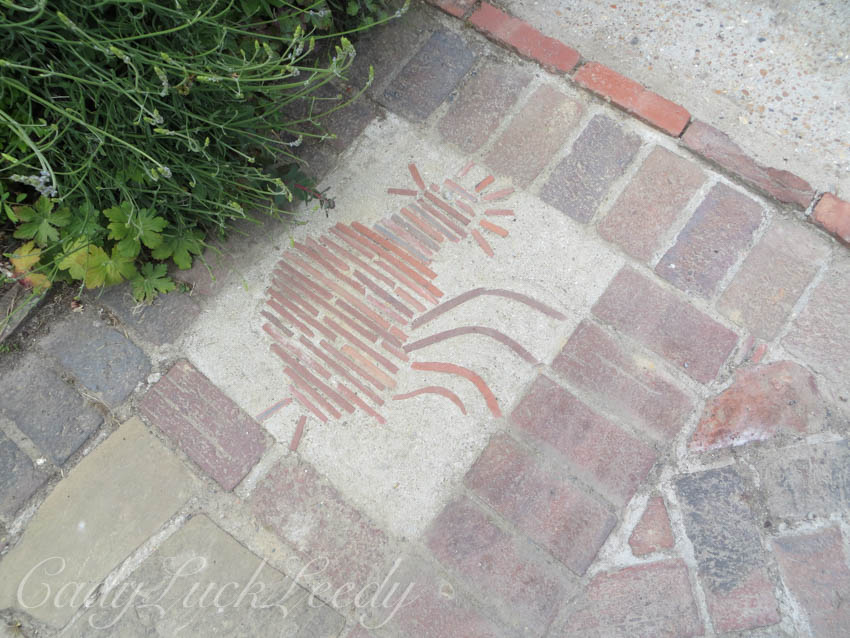
Art in the Garden Adds Interest, Whites Cottage, Fletching, Uckfield
Visiting the different gardens on the National Garden Scheme has taken us to very interesting small villages! Lets take a walk and see the village! Is this the Clergy House? Love it!
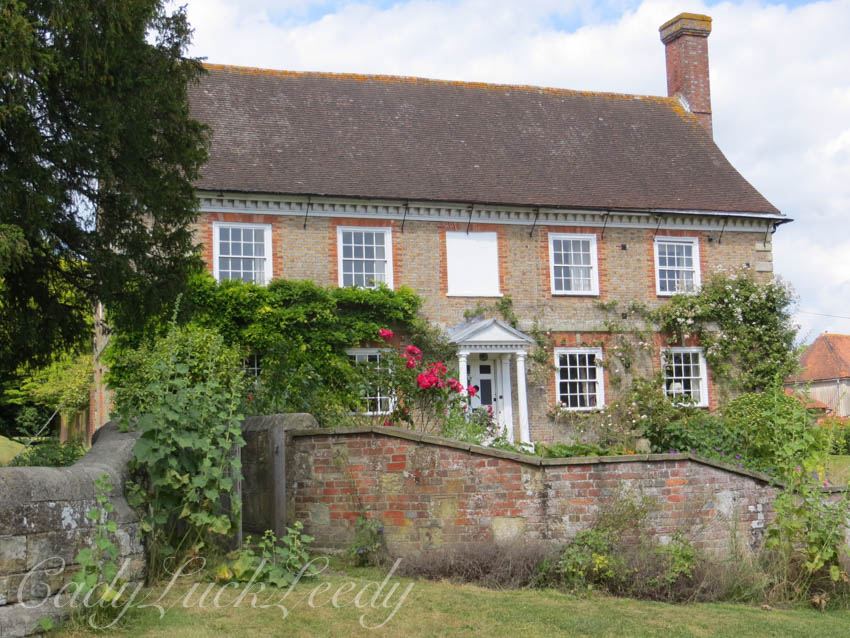
A Beauty Next Door to St Andrew and St Mary the Virgin, Fletching, Uckfield
Here is an old door to the Churchgate Cottage!
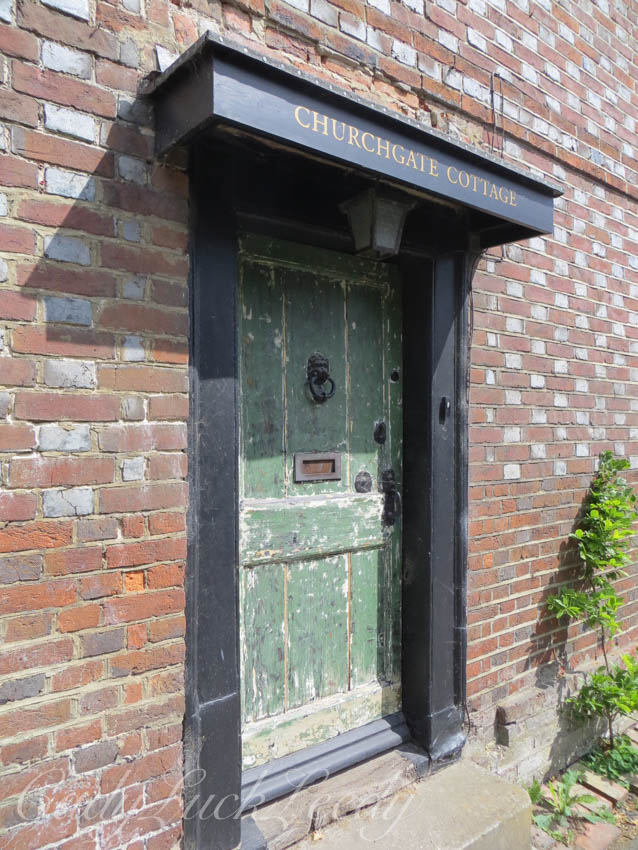
Another Old Cottage Door in Fletching, Uckfield
In medieval times Fletching was the major producer of bows and arrows; many were used in the battle of Agincourt in 1415. In 1912, The Piltdown Man was discovered near Fletching and thought to be the “missing link” between humans and apes. The significance of the specimen remained controversial, until amidst great publicity and much embarrassment in scientific circles, it was exposed as a forgery in 1953. I think their treasure lies in the beauty of their tiny dollhouse cottages! And maybe this delight, the Tudor Cottage.

The Tudor Cottage in Fletching, Uckfield
We still have several gardens to see on my “English Garden Tour.” Won’t you join me! Another village tomorrow!
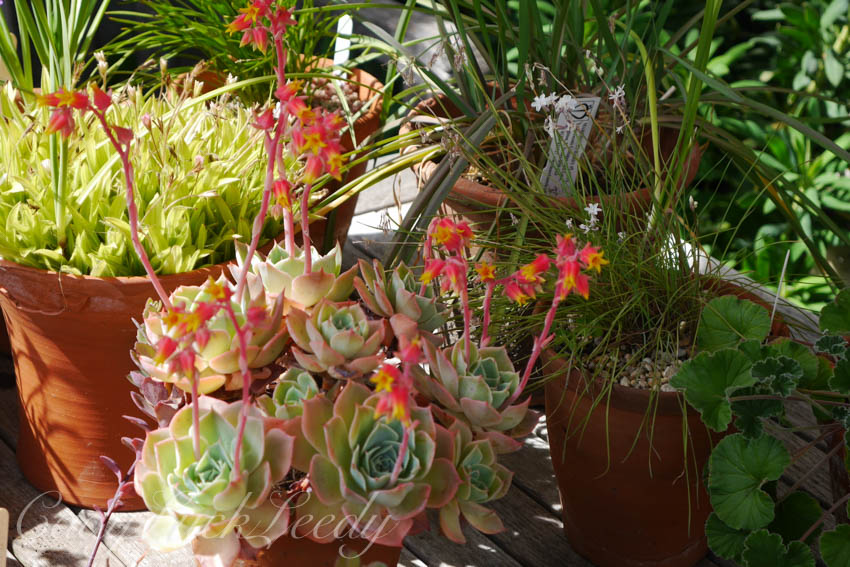
The Succulents at Whites Cottage, Fletching, Uckfield

Help! What Am I?
This was my favorite flower during my “English Garden Tour.” We saw it several times in many gardens, but no one was able to identify it. Can a gardener help me out? I loved the way it kept blooming on a single stem!
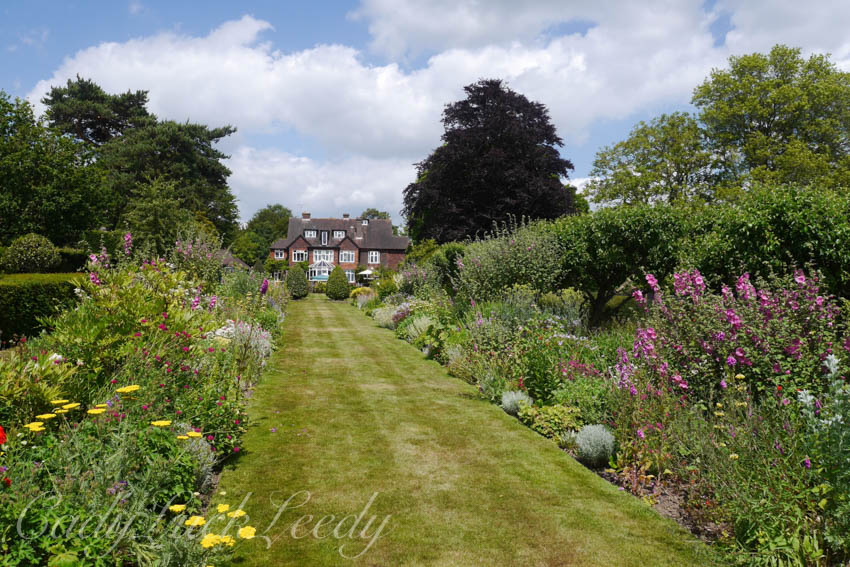
The Back Lawn of Luctons, West Hoathly, Sussex

The Back Lawn of Luctons, West Hoathly, Sussex

The Back Lawn of Luctons, West Hoathly, Sussex
It was so entertaining sitting on the terrace at the Cat Inn in West Hoathly watching the wedding guests stroll in for a wedding lunch. Such beautiful summer finery and oh the hats! Why don’t we wear hats anymore? I am always so envious of women in hats! So elegant looking in the smallest of fluff and feather!
Time to move on to the next garden, Luctons, just a short walk to the end of the street where the “newer homes” are. Talking with the owners, who have lived in their home for thirty years, we find there have been many adjustments and improvements to their 19th century home, green houses and two acre garden.

Herbaceous Borders at Luctons, Sussex

The Flower Garden at Luctons, Sussex

The Flowers of Luctons, Sussex
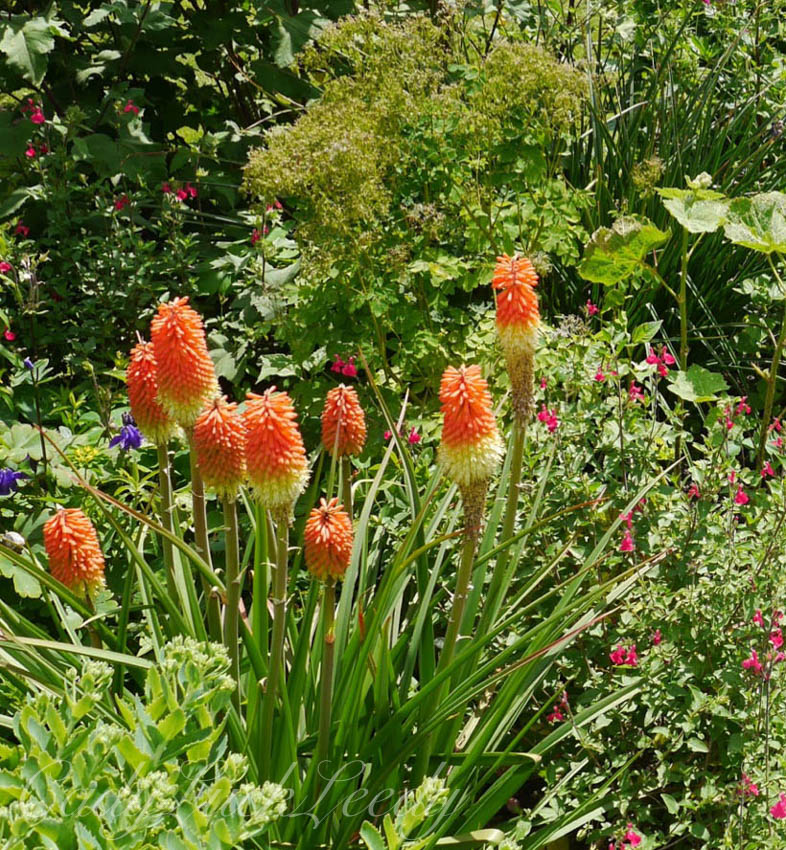
The Flowers of Luctons, Sussex
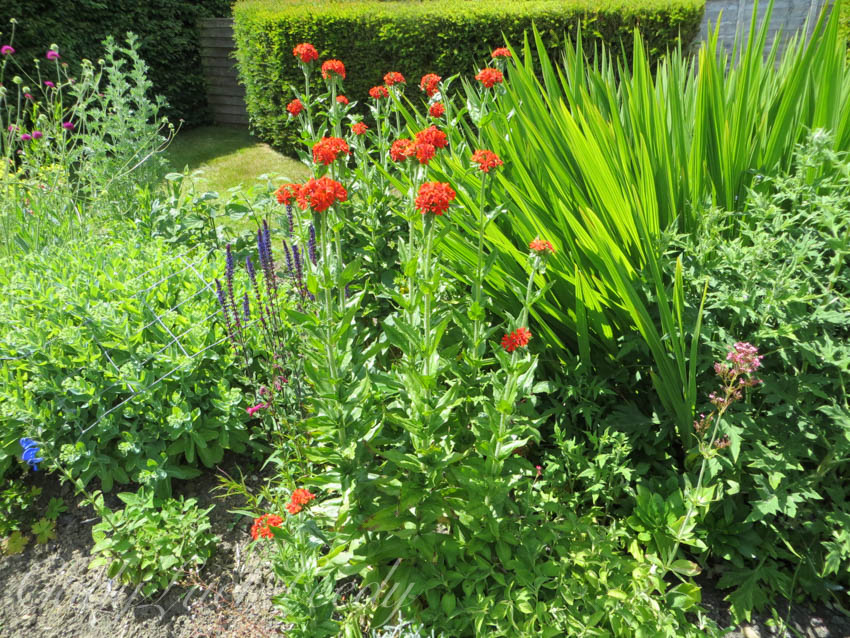
The Flower Garden of Luctons, Sussex
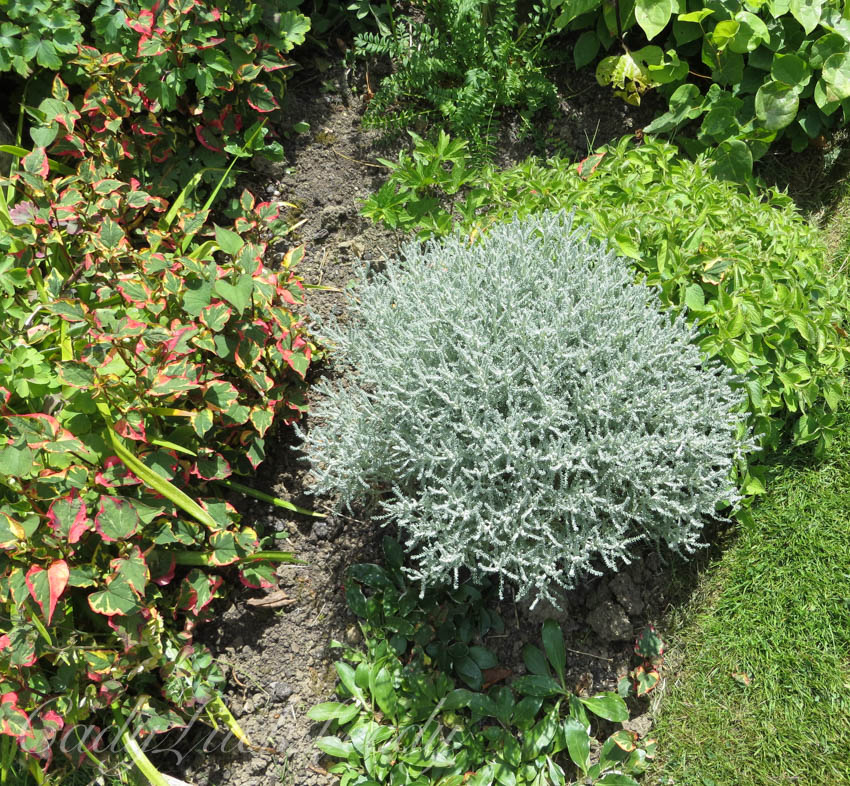
The Flowers of Luctons, Sussex
That is what I find so interesting about the gardens I have seen so far. You get a chance to talk with the gardeners/owners of the gardens and learn more about their garden plans, choice of flowers and involvement with other gardens and gardeners. This garden was designed in the Gertrude Jekyll style, which focused on a relationship between the house and its surroundings. Gertrude Jekyll’s style included foliage, color and texture to achieve a practical and beautiful view. To give a picturesque and natural appearance in the garden the use of stone walls, walkways, and natural partitioning of the garden, ensures a gentle flow. To quote the famous landscape gardener,” A garden is a grand teacher. It teaches patience and careful watchfulness: it teaches industry and thrift; it teaches entire trust.” At Luctons, we see the small box partere, yew topiary, shrubs and flowers that frame the front of the home giving it an inviting entrance. Won’t you join me for careful watchfulness?

The Front Entrance to Luctons, Sussex
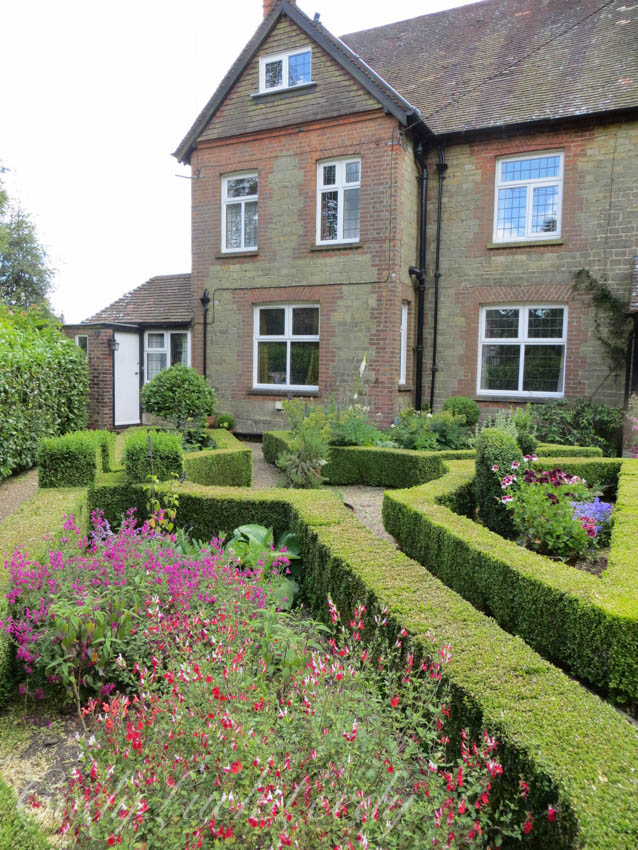
The Front Entrance to Luctons, Sussex
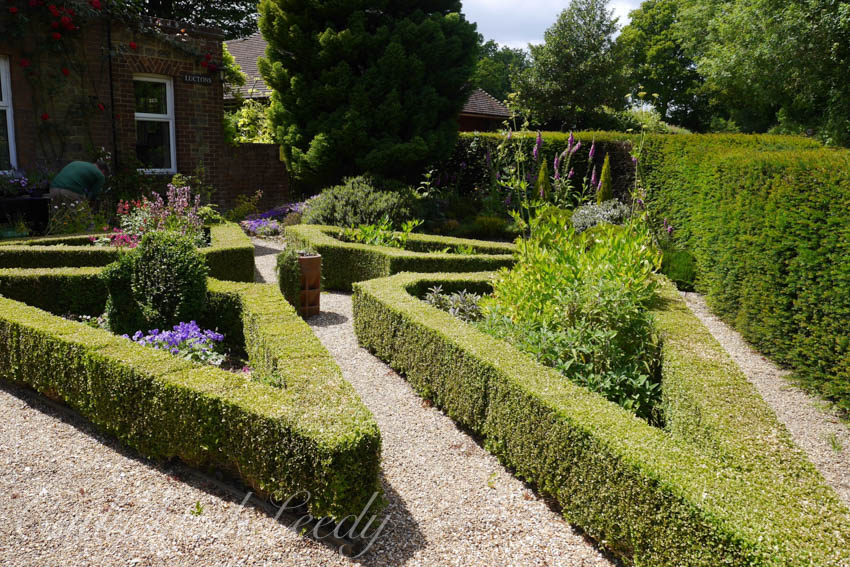
The Front Garden at Luctons, Sussex

The Front Garden at Luctons, Sussex

The Front Garden at Luctons, Sussex

The Peacock Topiary, Luctons, Sussex
In the back is a large lawn with herbaceous borders centered in a large fruit and vegetable garden.

Leading to the Cricket Court at Luctons, Sussex

The Vegetable Garden, Luctons, Sussex
The wild flower orchard is not mowed revealing beautiful meadow flowers and spotted orchids. A tent has been set up where cream teas are served. Could there be anything more English? All I need is my hat!

Tea in the Garden, Luctons, Sussex
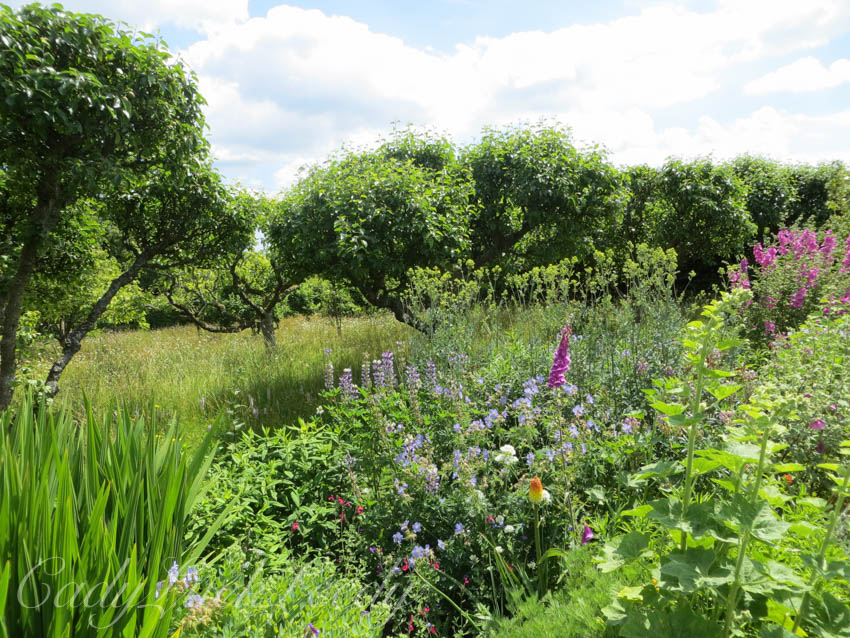
Looking at the Orchard at Luctons, Sussex
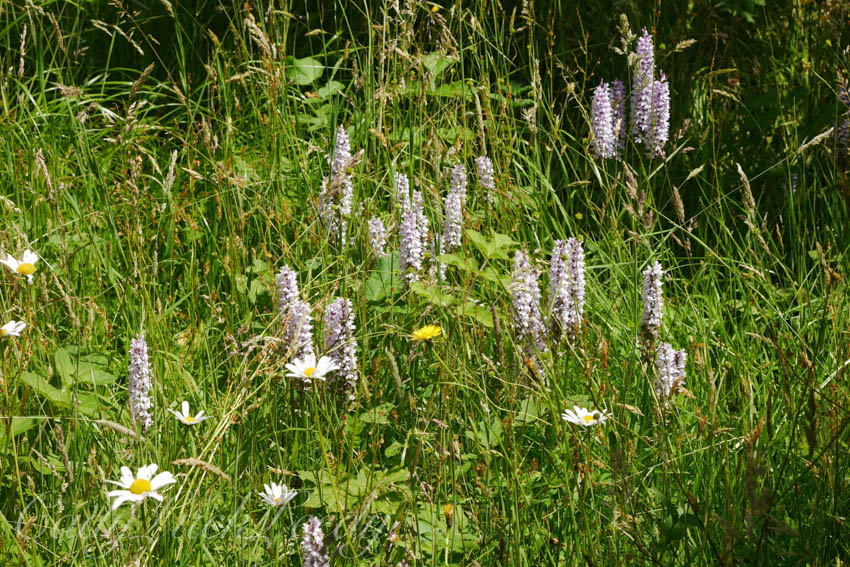
Spotted Orchids in the Meadow at Luctons, Sussex

The Lovely Unknown
PS This was hands down my favorite flower! I saw it in many of the gardens we toured, but could never find out the name of it. Can anyone identify it for me?

The Priest House, West Hoathly, Sussex

Map of Center of Village, West Hoathly, Sussex
Today we traveled to West Hoathly, in Sussex, to see the first gardens that I had chosen from the many offered this weekend on the National Garden Scheme. Driving well over an hour we arrived in the center of the small village of 9 homes, including the pub. The Priest House is our first destination. The only one of its kind open to the public, this 15th century Wealden hall house stands in a traditional cottage garden on the edge of the Ashdown Forest. Originally owned by Henry VIII it was given to Anne of Cleaves, wife number four, upon their divorce. The herb garden is planted with over 170 culinary, medicinal and household herbs. Today a special exhibition for the NGS, featured on the upper floor, built in 1600, reveals pictures of local children and their place in the workforce in the 19th century. Many children, as young as five and six, were farm laborers and chimney sweeps. It was not uncommon for the chimney sweep to get stuck in the chimney and die. The Priest House is maintained by the Sussex Archaeological Society and provides rotating exhibits, research, and other learning experiences.

Walkway to the Priest House, West Hoathly, Sussex
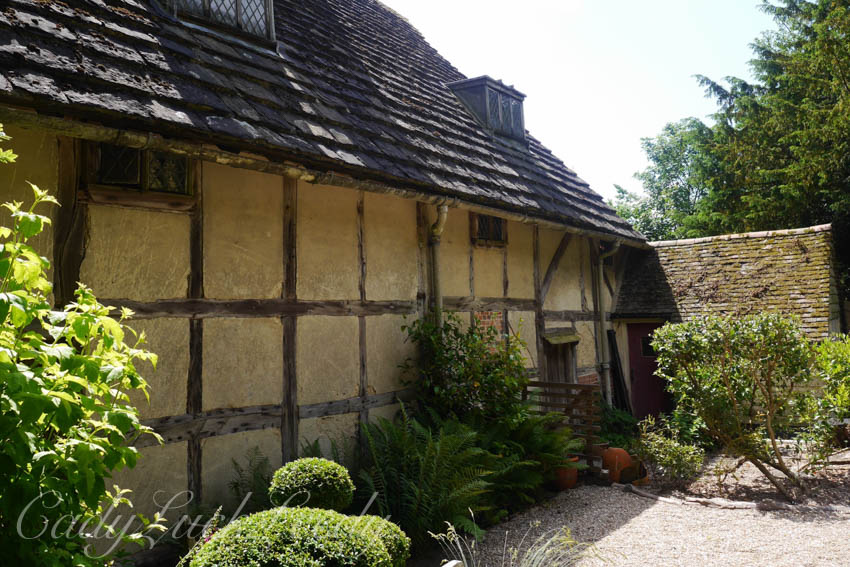
The Priest House, West Hoathly, Sussex

The Priest House, West Hoathly, Sussex

The Gardens at Priest House, West Hoathly, Sussex

The Gardens at Priest House, West Hoathly, Sussex

The Gardens at Priest House, West Hoathly, Sussex

Flowers in the Garden at Priest House, Sussex
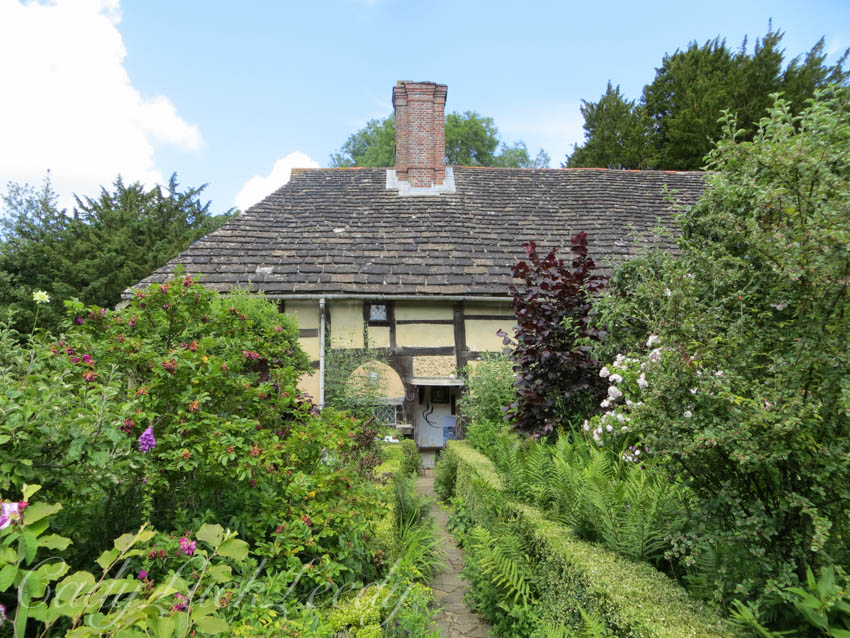
Another Garden at The Priest House, Sussex

The Priest House, West Hoathly, Sussex

The Priest House, West Hoathly, Sussex
St Margaret’s Church, settled in 1090, records the names of the village from Hadlega, later standardized to Hodlegh, then West Hoathly. This Anglo-Saxon word signifies a heath covered clearing, or the dense woodland of the Ashdown Forest. In 1556, Ann Tree was burnt at the stake near here for refusing to renounce Protestantism, one of seventeen martyrs to suffer this fate in Sussex. A brass memorial in the church commemorates her.

St Margaret’s Church, West Hoathly, Sussex

St Margaret’s Church, West Hoathly, Sussex

The Gate to St Margaret’s Church, West Hoathly, Sussex
The Manor House was built in 1627 for Mrs Catherine Infield of Gravetye Manor, as a dower house. Her family was the wealthy owners of the local iron works. Later abandoned to smugglers the buildings and grounds were rejuvenated in 1884 when “the greatest English Gardener” William Robinson bought it. Upon his death it was turned over to the Forestry Commission. It now sits vacant and forlorn.
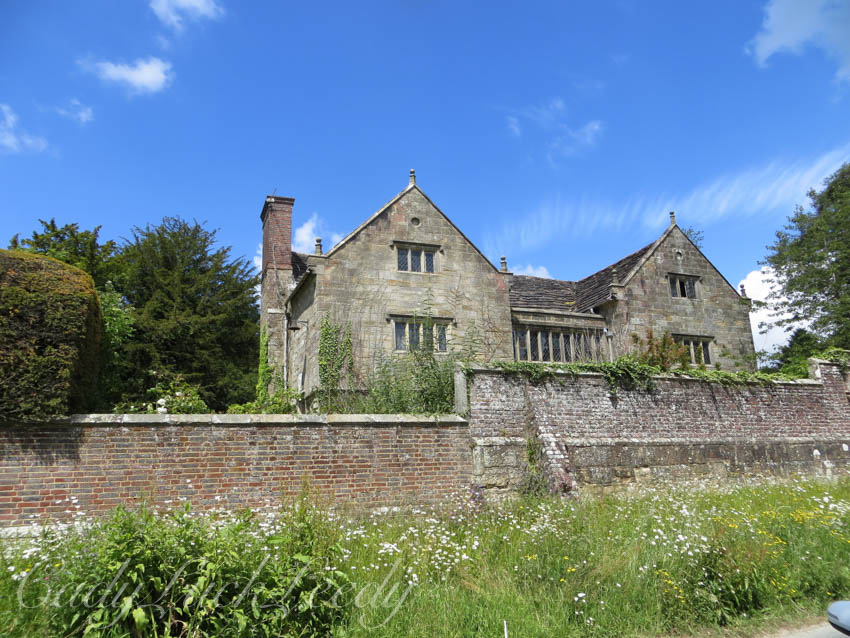
The Manor House, West Hoathly, Sussex
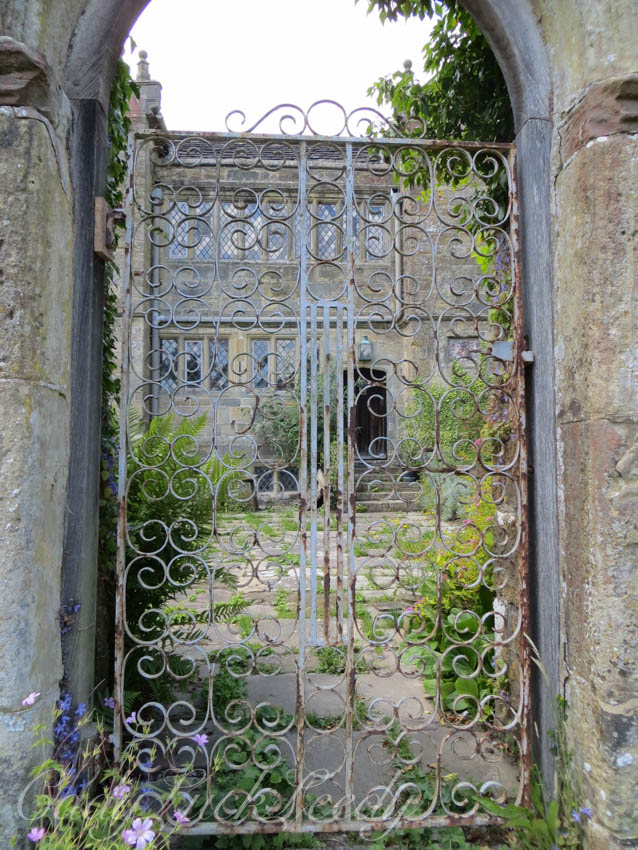
Looking Through the Gate to the Manor House, West Hoathly, Sussex
The Phlox and Rose Cottages are 19th century weather boarded over timber framed cottages. They were the newest houses in the village!

Rose Cottage and Phlox Cottage, West Hoathly, Sussex
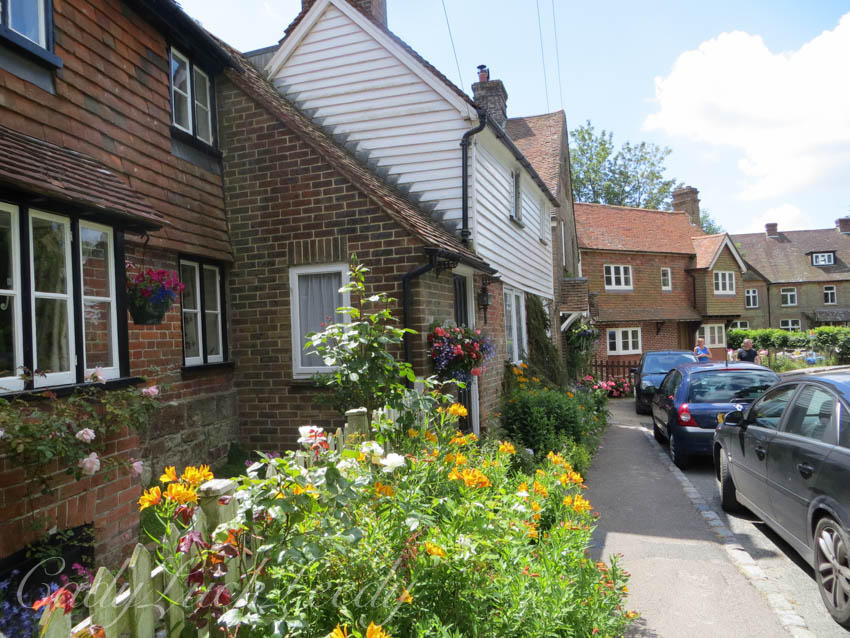
Rose Cottage and Phlox Cottage, West Hoathly, Sussex
The Upper Pendent is a timber framed, tile-hung 17th century home which previously housed the village stores and post office in the 19th and 20th centuries.

Upper Pendent, West Hoathly, Sussex
The Cat Inn is the 16th century pub of medieval origin standing in the crossroads of the village. The name is derived from an emblem of the Sackvilles of Knole, which is a leopard. We will be learning a lot about the Sackvilles, a very prominent family in Kent. This is the pub I had picked to stop in for lunch after touring the village. It was highly recommended by the locals also. We sat in the lovely terrace and had a most agreeable meal. Now on to the next garden in the “burbs” of West Hoathly.
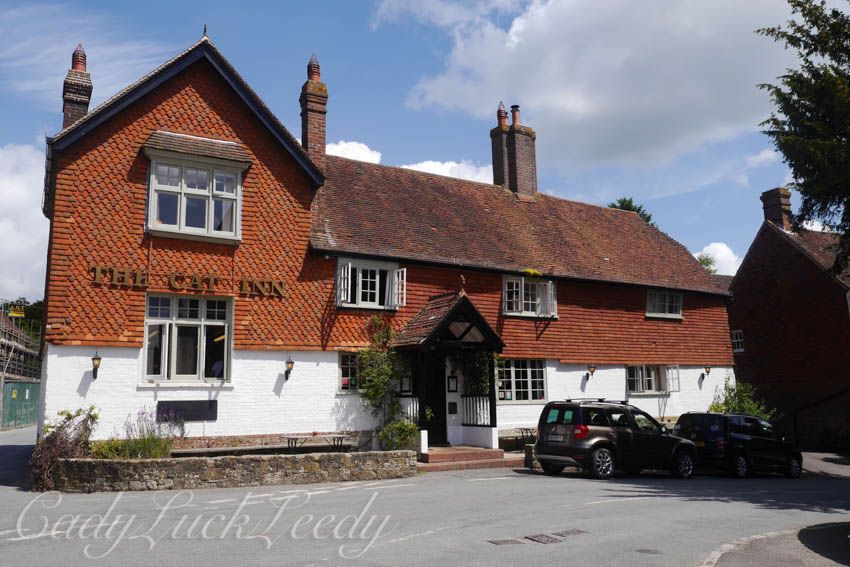
The Cat Inn, West Hoathly, Sussex

A Great Ride Awaits at the Cat Inn, West Hoathly, Sussex
P S For a good read about the wives of Henry VIII, I suggest, Six Wives of Henry VIII by Alison Weir. The author draws on early biographies, letters, memoirs, account books, and diplomatic reports to bring each woman to life. Very interesting!

A Garden in Kent UK
Of all the delectable islands, the Neverland is the snuggest & most compact…… not large and sprawling, you know, with tedious distance between one adventure & another, but nicely crammed.
J. M. Barrie, author of Peter Pan.

The Yellow Flowers
When it comes to gardens I like nothing better than to stroll, admire the collections of beautiful flowers, and imagine the inhabitants of the house and how they like to garden. I especially like the messy, scattered garden with vines dripping over the garden gate, and paths that invite you to explore. It’s even better if there is a flower box of riotous color haphazardly framing the window ledges of the small cottage, nestled in the garden, as if just plunked in, as an after thought. Pieces of art and sculpture placed in a specific spot draw your eye and add to the charm of the garden. I have just returned from several weeks in the United Kingdom, specifically in Kent and Sussex, traipsing through local gardens and visiting magnificent estate homes with acres and acres of gardens. Whew! We lodged in a barn in the middle of the weald, down a mile-long gravel road, wide enough for one car at a time, passing by the field of rabbit warrens and watching for the hop of a bunny on our daily treks into the countryside.
Planning our adventure was one of the fun “bits.” I love the “planning” part! Where to go, what to see? One thing leads to another. First, I looked for places I knew would be of interest. What about the Chelsea Flower Show? No, too crowded and I wanted more rural. Hever Castle during Rose Week? Closer, but not quite right. Then I read a wonderful book, called A Fine Romance, by Susan Branch. It’s about falling in love with the English countryside and her adventures when visiting England.
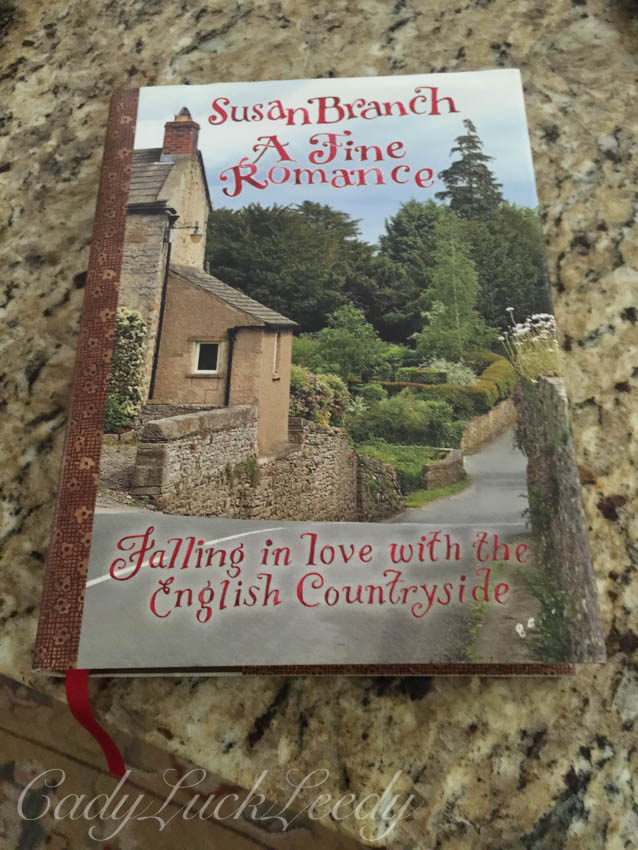
A Fine Romance
I loved it and the more I read the more I was drawn to Kent and the village of Tenterden. So, I set out to learn all about Kent and especially Tenterden. I also learned more about the National Trust. The National Trust, since 1895, has been preserving the countryside and hundreds of historic properties in England, Wales, and Northern Ireland. I first heard of it when reading all about Beatrix Potter and her home in the Lake District, which was left to the National Trust. The properties restored include huge estates to the small and quirky. Just right up my alley. So our first priority was to join the National Trust, (it’s called the “Royal Oak Society “ in the U.S ) which allowed us to receive a handbook with maps of all the places to visit with the National Trust and a pass to get in all of them for a year and a pass for parking at the different locations.

National Trust Book 2015
What a must this is! You don’t realize all the places available to visit until to see them on the maps! So that was a reference point to start with. Where could we set up our “base camp” closest to the sites we wanted to see? Well it still remained Tenterden for us. Then I heard about the National Garden Scheme. What in the world was that? Had to research it before final decisions were made!
The National Garden Scheme was founded in 1927 to open “gardens of quality, character and interest to the public for charity.” Originally the admission fees raised money for district nurses. This was changed in 1948 with the formation of the National Health Service. The National Gardens Scheme has given more than 43 million pounds to nursing and care facilities since the time it opened. Since I am a retired RN this was near and dear to my heart. These are “local” gardeners and their gardens. No big estates, (but some seemed to me like they were!) One woman I was chatting with on our walk through a local garden invited me to her garden, as well, which was not on the list, but exclaimed, “it’s only 12 acres, of course.” So as you can imagine, we visited the “potager,” snuggled behind the small cottage, to large landscaped gardens with “rooms” of flowering blooms. All gardeners were proud of their gardens, more than willing to tell you about them and happy that they were able to do their “bit.”
In 2013 there were over 3700 gardens open, which were all vetted to make sure they are all of sufficient interest. Each gardener opens his garden (usually on a weekend), one or two days during the year. I was so excited! But, it takes some planning! “The National Garden Schemes, “Yellow Book”,” can be purchased each year, which lists all the gardens and when they will be open.
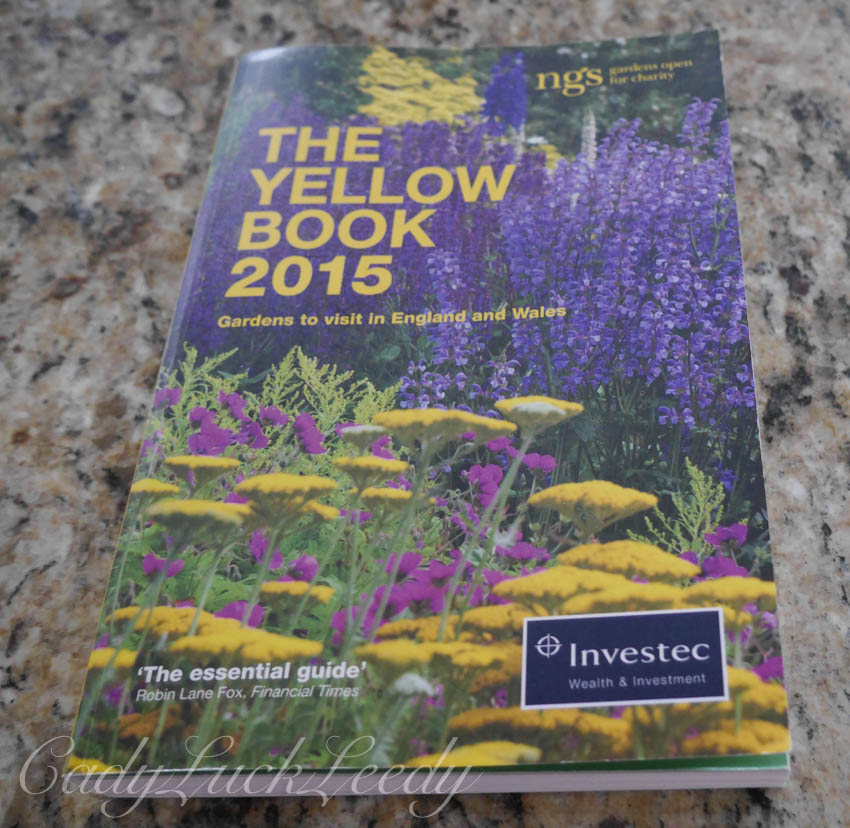
The Yellow Book 2015
Maps, directions, type of garden, and particular interest are included. We were really in the thick of the countryside when directions would reveal, “just go down the gravel road for a mile and then when you get to the yellow mailbox turn right on that gravel road and proceed on to the canal road and windmill place. Light refreshments offered.”
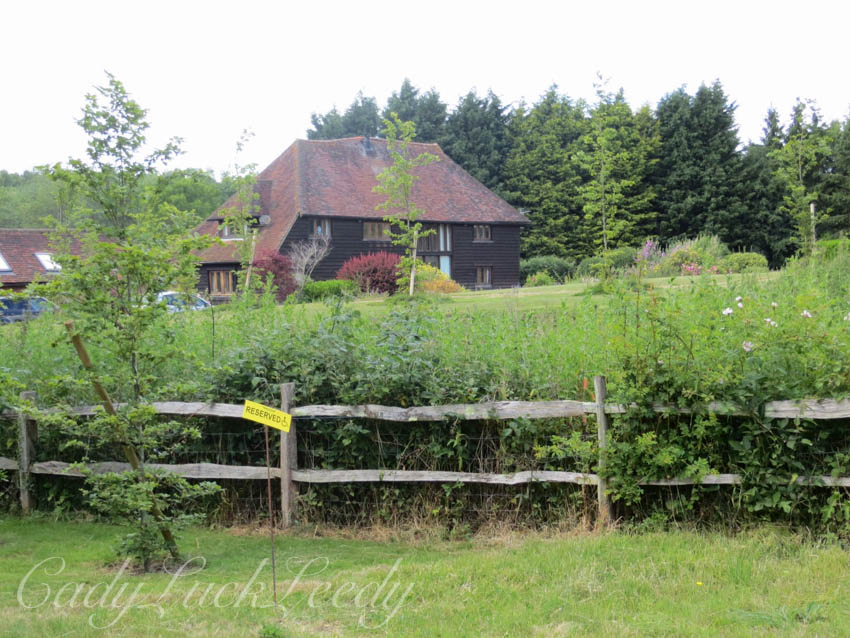
The Countryside Garden
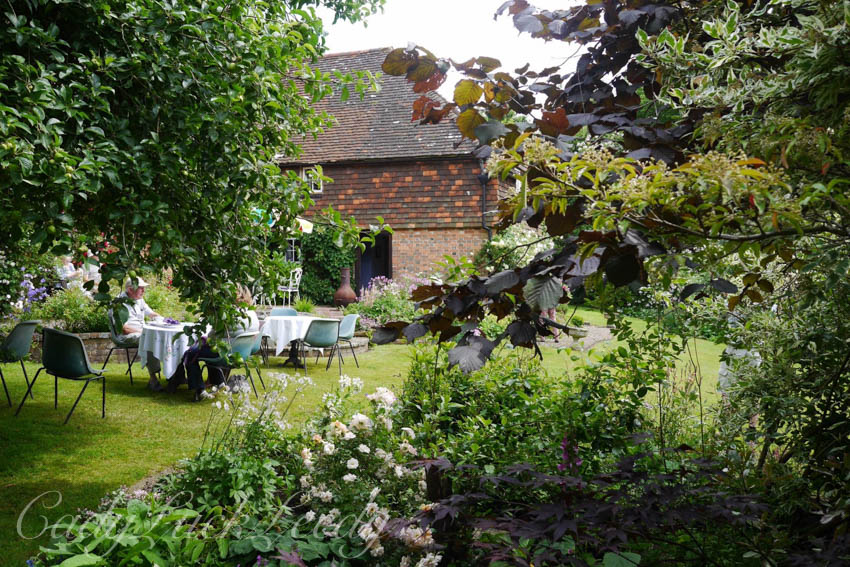
Tea In the Garden
This as going to be one of our best adventures! So after months of looking up gardens and coordinating them with places on the National Trust we were ready to make our way to the “Garden of England,” Kent. We were about to set off on a gardener’s dream! See you tomorrow on our way to the garden!
A few weeks ago I wrote a post for the genealogy section of Dominic’s blog, Flibberatic Skreebles. He also writes at A Wiltshire Garden. This is a post that he so thoughtfully wrote for me about gardening. Enjoy! Thank you Dominic!
Growing up in a small Wiltshire village amidst the rolling hills of south-western England, I had what most would call a typical childhood relationship with our garden. That is, the edges of the garden borders became havens for my various wild animal toys. The lawn was turned into prairie, savannah or – more prosaically – farmland. Camp outs, snail hunts, hedgehog spotting and somewhere to play and be free. I can’t say that I consciously took a great deal of notice of what was around me.
I did, however, notice that not everybody had such a garden as mine, that not everybody’s mother spent hours in a greenhouse or would spend hours in a garden centre (or carried a small penknife with her when she went on trips to public gardens so she could ‘appropriate’ cuttings). I also noticed that not all of my friends ate vegetables fresh from the garden. I began to taste the difference between a tomato picked fresh from the vine not more than 10 minutes before and one that was taken from a plastic box out of the fridge. It was then that I realised I didn’t have what other people necessarily had: a constant and early exposure to horticulture.

“My Mother’s Garden, 2005.
Of course, gardening isn’t something new. As soon as humans ear-marked permanent homes then the local environment was altered – beneficial plants collected and protected, undesirables eliminated and foreign species introduced. The enclosure of outdoor space began around 10,000 BCE – and the words garden and yard both come from the Old English term geard which means fence or enclosure.
The Romans may have imported their own views on gardening – a separation of the aesthetic beauty from the pragmatic fruit and vegetable (i.e. kitchen) garden – but I can’t imagine pre-Roman Britain devoid of domestic spaces that yielded produce for the household. This produce would’ve been primarily limited to plants with culinary, medicinal or other practical uses (violas were often strewn on the floor to release their aroma when stood upon, for example, as well as their leaves being used as a potherb to flavour soups and stews).
Whilst gardening trends came and went with the owners of large houses – Italian Renaissance, French Baroque, English Romantic – the general population, predominantly rural in nature, continued with their own home gardens. These were used to grow fruit and vegetables that weren’t available elsewhere – after all, there were no supermarkets and no greengrocers conveniently around the corner stocking all foods in all seasons! These spaces also included animals such as poultry and often a pig or two (my mother remembers quite clearly her grandparents fattening up a pig each year in a sty at the bottom of the garden and then sending it to slaughter).
Of course, as the Industrial Revolution and Enclosure movements* came about, more and more people were migrating into urban areas and these towns and cities exploded. There wasn’t the space for people to grow their own produce or the leisure time to dedicate to these pursuits. However, as the 19th century continued, the Victorian philanthropists realised that the poor would benefit both physically and spiritually from having outdoor areas in which to grow their own food.
(*It’d be a bit outside of this post to discuss the Enclosure movement in England – but suffice to say that it changed the face of the British countryside by chopping up the open field system, and allowed the wealthy landowners to own more land and accumulate more wealth at the expense of their tenant farmers.)

“Allotments in Bath, England.
Areas given over to growing produce for private use (as opposed to areas used for growing food to sell – market gardens) were nothing new in England. These allotments were parcels of land rented from a central local authority and each individual is responsible for his or her own patch – and often include a shed of some kind. (This aspect of one parcel of a much larger area being managed individually makes them different from community or victory gardens – more on which later!)
Allotments have gone in and out of fashion over the years – with the most recent peaks being during WWI (1,500,000 plots) and WWII (1,400,000 plots) – but over the last few decades the numbers have started to grow again with demand outstripping supply. This is seen to be a reaction against growing food prices and modern agricultural practices, as well as consumers demanding a greater awareness of where their food comes from.

“Dig For Victory, UK WWII Poster”
Victory gardens sprang up on both sides of the Atlantic during WWI, with household yards, parks and public areas being turned into vegetable and fruit gardens in USA, UK, Canada and Germany. In America alone over 5 million gardens were created during WWI. In WWII England’s gardeners were exhorted through the “Dig For Victory” campaign – and waste ground, railway verges, lawns and sports grounds, even areas of Hyde Park in London, were requisitioned for the purpose. After WWII the majority of these English victory gardens reverted back to their pre-war state. In America it was common to see vacant lots and apartment building roofs as gardens – something that has come back into vogue with not only the guerilla gardening movement but also the rise of urban gardening and food production.
Guerilla gardening is a global movement, defined as “an act of gardening on land that the gardeners do not have the legal rights to utilize”. This includes such diverse areas as verges, roundabouts/traffic islands, tree pits, bus stops or even potholes in roads! This is often done to highlight the neglect of certain areas of land, but also to foster a sense of community or to raise a smile on passersby.
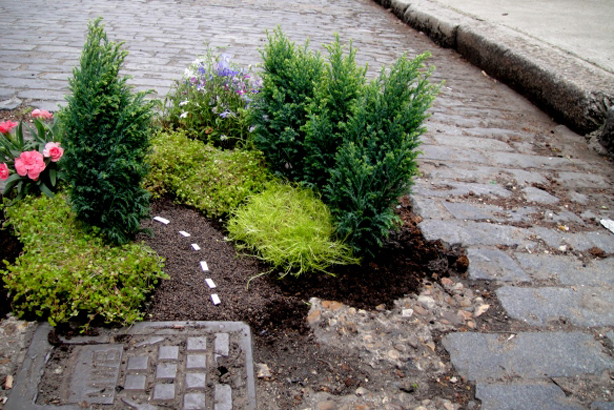
“The Work of UK Pothole Gardener Extraordinaire, Steve Wheen”
Of course, along side this guerilla gardening is the increase not only of urban greening but also of the regeneration of the community gardening movement used to change not only the inner city landscape but also the mental health of people using them – one community garden based in the UK is being used by local doctors to help patients with depression and anxiety disorders.
One thing that the rise in the number of these activities highlights is that gardening isn’t going anywhere. Its been part of the British landscape for as long as there have been people around to pull up an unwanted plant and replace it with something else, and despite the rapid urbanisation of the country around us, the desire to plunge your fingers into some loam and watch the beauty that follows is still with us. And long may it last!
For more information on any of the in the UK, please visit some of the links below!
Guerilla Gardening – http://www.guerrillagardening.org/
Groundwork – community greening charity – http://www.groundwork.org.uk/
Project Dirt – social network for green communities – http://www.projectdirt.com/
The Edible Bus Stop – from one community garden to an entire scheme – http://www.theediblebusstop.org/
Landshare – social network connecting growers to those with land to share – http://www.landshare.net/
Federation of City Farms & Community Gardens – https://www.farmgarden.org.uk/home
National Society of Allotment & Leisure Gardeners – http://www.nsalg.org.uk/
Kabloom Seedboms – a mixture of compost and seeds – http://kabloomshop.co.uk/products
Tales, Thoughts + Tribulations of a Free Spirit in Suburbia
Travels on foot
Minding my mind, one thought at a time.
Un lungo racconto fotografico.
Featured
Photography, hiking, walking, and cycling across central Japan — from quiet mountain paths to everyday life around Nagoya.
Looking for meanings in words, images and sounds
Reflections on places traveled and photos taken.
Cruising with the Thyrre Family
Where my Travels and my Blog merge together.
The mental meandering that cross my keyboard
Website & Blog of J. Kelland Perry, Author
A photographic journey.
Photography celebrating flowers, plants, and the natural world
Roaming, at home and abroad
The Corner Garden
Photography, Travel and Retirement
Upgrade Your Travels. First Class Luxury Travel from all parts of the Globe. Business Class Airline, Lounge and Hotel Reviews, Stories and Adventures
A China travel and lifestyle blog

 The Travel Lady In Her Shoes