Travel, Gardens, Food, Photography, Books, Shoes

Posts tagged ‘Lodging’

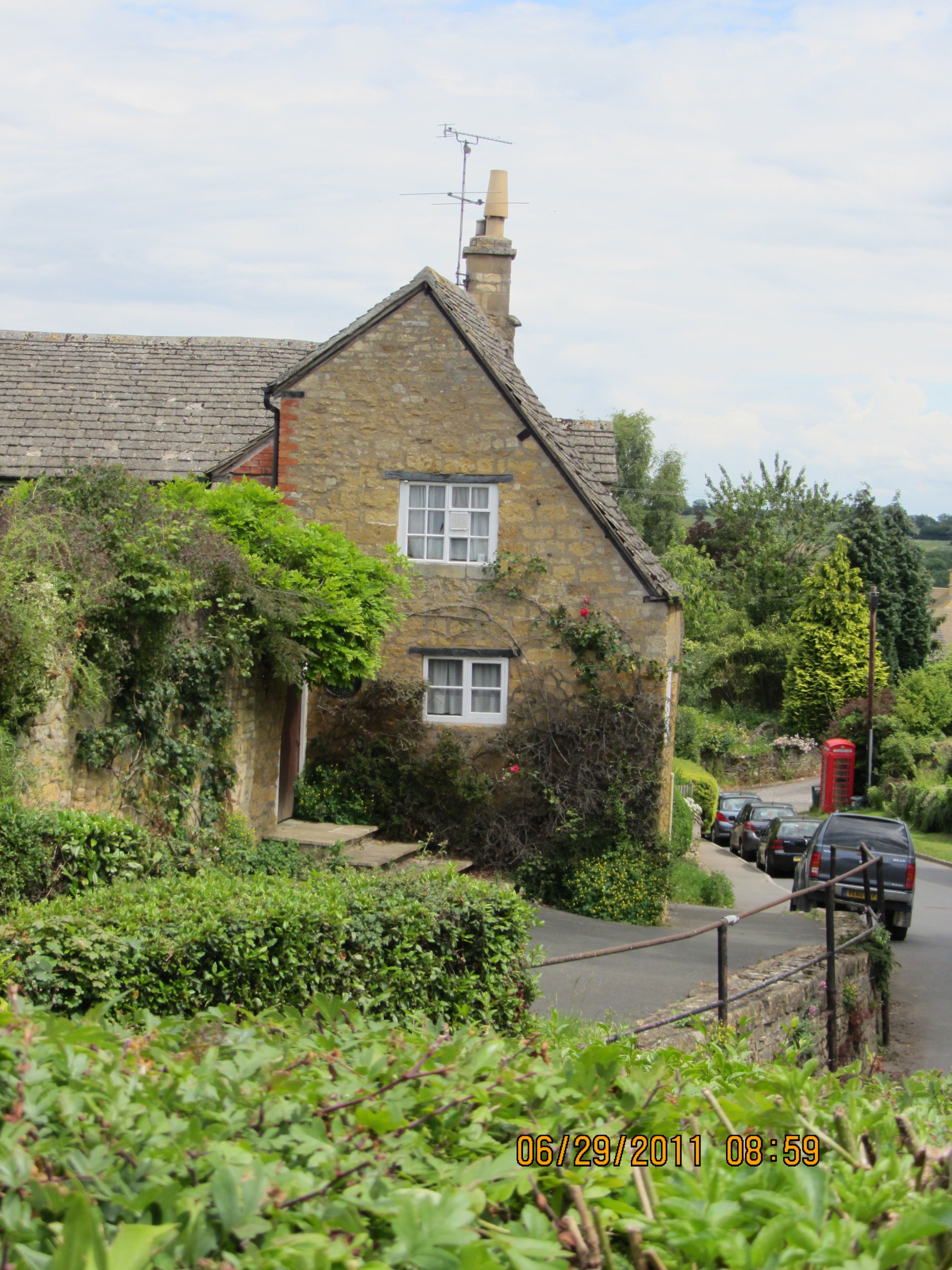
A Cottage in the Cotswolds: Ebrington


Oak Cottage Gate, Ebrington, UK

Oaks Cottage Gate, Ebrington, UK


I met a lovely man in a Chipping Campden clothing shop on High Street, who asked me what brought me to the village. When I answered, “my ancestors,” he invited me to his village and church in Ebrington. You see, I am making my way to Kinlet, Shropeshire, UK and St John the Baptist Church, where my ancestors, Sir Humphrey Blount and his wife Elizabeth, are buried. 

Ebrington, UK

Ebrington, UK

 Ebrington, a village of narrow lanes and tiny streets of Cotswold stone cottages and thatched roof cottages, is a just a short walk from Chipping Campden. The Ebrington Arms Inn and Pub, is a great place to eat and quench your thirst before exploring.  The Inn features guest rooms, a restaurant and pub, the hub of village life. The Inn was packed and will not disappoint you.   Walking up a short hill I came to a narrow lane, walked past the Church Steps Cottage and on into the gate of St Eadburgha, named after Eadburgha, the daughter of King Edward the Elder. The tower and south doorway of the church are believed to date from the 13th century, but the church, like most ancient churches, has been enlarged and restored over the years. Stepping inside the church, which is not locked like so many these days, there is  a stone coffin, lepers seat, and other ancient  architectural  details. Be sure to read St Paul’s Admonitions to Wives and Husbands to the left of the font! St Eadburgha’s  Church stands on a commanding position on one of the highest hills in the Cotswolds and the tower can be seen for miles around.  We loved the thatched cottages, stone walls, garden gates and abundant flowers in Ebrington. I discovered that the bird, that I thought was rather still for a long time on one of the cottages, was part of the thatched roof and made of straw! Every cottage had a name, and upon returning home I was determined to name my own, The End Cottage. Not far from Ebrington, is Hidcote Manor, a National Trust Garden, one of the most lovely gardens in the UK.  The day we were here it was closed, bummer, but what a wonderful excuse to come back to the village of Ebrington! Enjoy!

For more information about the Ebrington Arms Inn and Pub see:

Home


The Church Cat at St Eadburgha's

The Church Cat at St Eadburgha’s

Montepulciano Revisited

Our Apartment, San't Antonio

Our Apartment, San’t Antonio

We are back in Montepulciano, making it our base camp for exploring the surrounding hill towns of Tuscany. After renting a car in Florence and driving to San Gimignano, now here we are on Saturday evening getting settled in at Sant’ Antonio, the restored apartments on the grounds of an old monastery, in the hills around the village of Montepulciano. Late afternoon is spent meeting other guests from all over the world, who will also be spending a week here in Tuscany exploring. After our brief introduction to each other, the local maps were passed out, and we all decided to head out to the grocery store in Montepulciano before the store closes at 6pm.  The store is not open on Sundays, so we must get in and get out if we want anything to eat or cook while we are at Sant’ Antonio.  It was a mad dash to the grocery store! Parking is limited, and the store very busy, so we parked in the church parking lot and walked down to the store. A hint in the grocery store; we had to put one euro in the grocery cart to use it in the store and when we brought it back in we got the euro back. Also, do not touch the fruit or vegetables without putting on the plastic gloves that are provided! We were warned by our hosts about this!  Although, when I shopped in the smaller shops up the hill in Montepulcinao, this did not seem to be the case. In the smaller shops the attendant was quick to help me with my selections.

We explored the hill towns during the day, all the guests going in different directions in their cars.  It was fun to sit on the veranda in the evenings and over a glass of wine and nibbles find out where everyone went during the day and what they liked about the places they went to. Our neighbors to the left of us were German and Spanish.  Our neighbors to the right Canadian, and in the family apartment a group, who came here every year from Hawaii.  There were other guests in apartments here as well, so we were a large group of 25 or so. On one evening, during the week, we all came together to share an evening meal, prepared and served by our hosts, in the large meeting room on the premises.  There was also a pool here in case you didn’t want to do a thing but relax. The other option is staying in the village of Montepulciano itself. Sant’ Antonio now offers apartments in town as well.

Another time I stayed in the Politian Apartments, when I came to Montepulciano to study Italian at the Il Sasso Language School.  At that time, I didn’t have a car.  The Politian Apartment was in the village.  It was a huge two bedroom apartment with all the amenities, (washer, dryer, microwave, big stove and oven) and tastefully decorated with antiques. There was a beautiful walled garden that I enjoyed sitting in to do my homework. The owners were on the premises and more than helpful.  There were other guests staying in other apartments, but I was up early and off to school so didn’t get to know them. We all seemed to have different agendas as they only stayed a few days and then were gone and replaced by new guests. The shops and restaurants are plentiful and the locals very friendly. Parking is LIMITED and outside of the village.  The streets are pedestrian-only, but a tiny, tiny bus goes through town from the bottom of the hill to the tippy top. It only stops at the bottom of the village, (the entrance), a designated place in the middle, and the very top of the village. If you stay in the village be prepared to haul your luggage up, up, up the hill at some point!  Pack light! For more highlights of Montipulciano see past blog posts about the Politian Apartments and the Il Sasso Language School. These are some reflections if you want to make Montepulciano your home base for visiting Tuscany.

Next we are off to the hill towns!

For More information about Sant’ Antonio Apartments see: http://www.santantonio.it

For more information about Politian Apartments see: http://www.politian.com

TTT, Traipsing Through Tuscany

Today starts a new Series in Italy, called TTT, Traipsing Through Tuscany.  Traipsing through the hill towns to be exact. Getting off the beaten track has been some of our best excursions! A bit of advice, we flew into Florence where we took a cab into the city. So we will begin in Florence. After spending a week here we went back to the airport and got a rental car to drive on through Tuscany and the hill towns.  We spent  a week in Montepulciano. As a home base it was perfect.  We explored surrounding hill towns, always coming back to Montepulciano in the evenings, and then we drove on to Rome. We dropped the car off at the Rome Airport and took a cab into Rome, where we stayed another week.  Much easier!  You could not pay me enough to drive in the bigger cities and spend a great deal of time just looking for a place to park.  There aren’t any parking spaces to be found! Save yourself the headache!

Florence, by far is my favorite biggish city in Italy.  It is easily walkable, with museums, restaurants and shopping galore. If museums are not your thing, there is plenty of beautiful outdoor art such as sculptures, icons, buildings, bridges and churches to keep you interested. One of the rituals, near our hotel, was a woman artist who sketched daily with colored chalk on the pedestrian-only street. This was truly a street scene because her sketching would cover a large section of ground. She would work on it all day. It was beautiful!  Very early the next morning between 4am and 5am the street cleaners would come through with their brushing machines and  brooms and wash it all away. Around ten in the morning she would start again with a new scene. Unbelievable!

To see the highlights of Florence we took walking tours that also included the museums. We tried for months to get tickets for the major museums and there were none to be had online. They were available through tour groups. In the end it worked out well because we never had to stand in line to get in the museums, and there were long, long lines. The downside is WE could have spent more time IN the museums, hours and hours. The tour group went to the major and most appealing exhibits, and that would be fine for most. The four tours we took were offered by Art Viva. They were the Original Florence Walk, the Masterpieces of the Uffizi Gallery Tour, and the Original David Tour.   These walks are long, at least three hours each with additional time added for the museums! Wear comfortable shoes! The English speaking walk leaders are very knowledgable, and we stopped occasionally for a cuppa, (wine, coffee, tea) always at good locations for people watching! We took three tours in one day and I was pooped, but from then on we knew where everything was and went back to the areas we wanted to spend more time in on other days.  On another evening we took the Original Evening Walk in Oltrarno, which included a wine and olive oil tasting!  We had a wonderful time on these walks and there are many to choose from!

On this visit we stayed at the Hotel Davanzati, a small boutique hotel located near the Uffitzi Gallery and right across the street from where the Original Florence Walk started each morning. This was good because we didn’t have to walk a great deal before we started the walk. Entering a doorway in the historical area there are a number of stairs to climb to reach a tiny elevator that takes you to the reception area and then to the upper room floors of the Davanzati Hotel.  The owner and his son were there everyday to recommend restaurants and sights to see, provide maps and answer any questions we had.   The breakfasts and late afternoon wine/happy hour gatherings were a big hit. The rooms were tastefully decorated and immaculate. After a lovely week in Florence we were in a rental car and on our way to Montepulciano, to get a taste of the countryside, the hill towns, and the slower pace of Italian life. See you in San Gimignano!


For more information about Hotel Davanzati see: http://www.hoteldavanzati.it

For more information about the Art Viva walking Tours see: http://www.italy.artviva.com

Ring Around the Kerry

This is my last posting of 4, of the Going Green to Ireland Series.

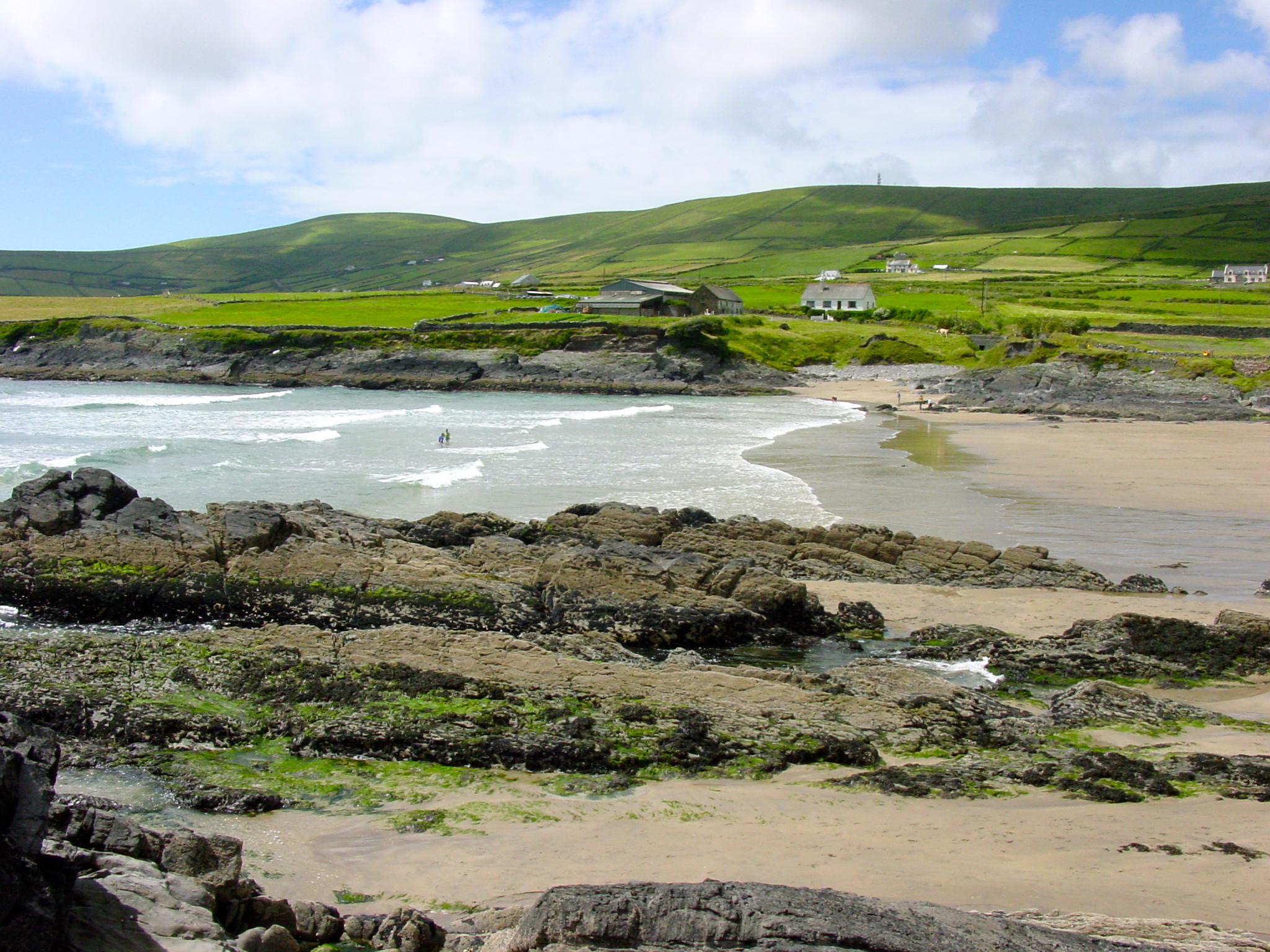
St Finian's Beach

St Finian’s Beach

We are on a long circular stretch of road called the Ring of Kerry from Killorglin to  Kenmare. We are adding in the Skellig Ring, a twenty mile, bus free ring road, traveling out to Portmagee. Here we reach St Finian’s Bay, where we will staying at the Beach Cove B&B, owned by Bridie O’Connor.

The Beach Cove B&B

The Beach Cove B&B

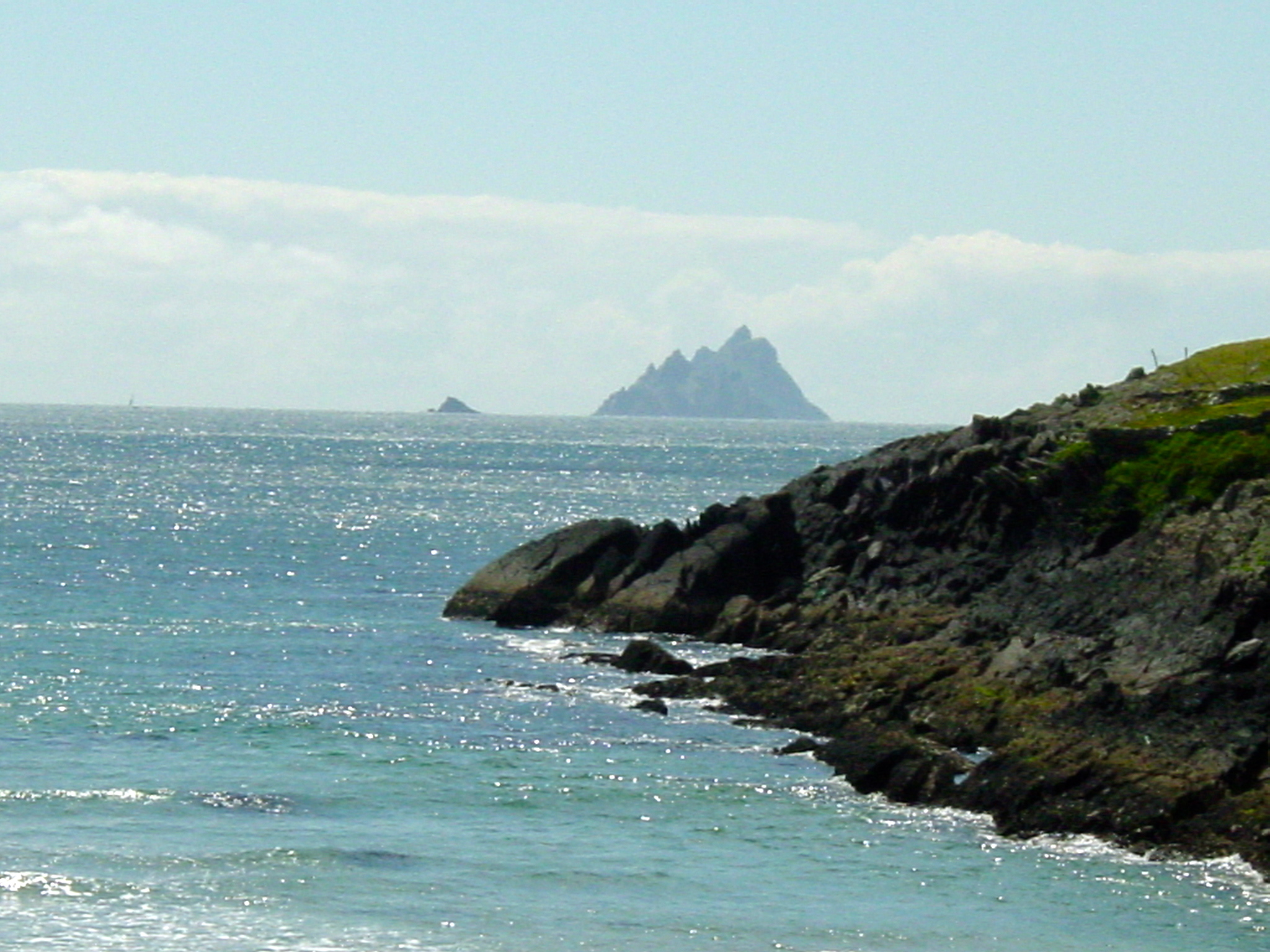
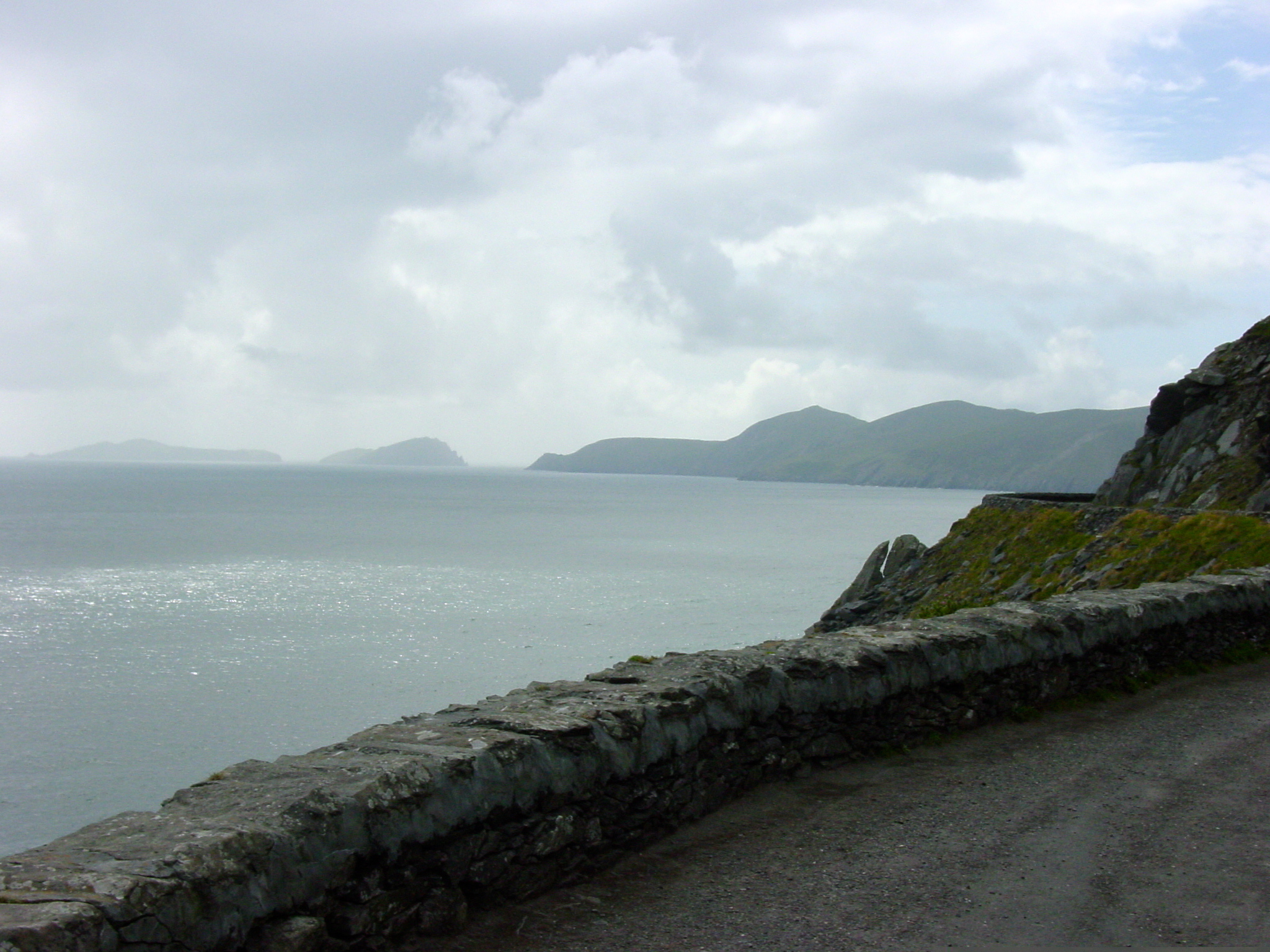
She offers four comfortable rooms on Coomanaspic Ridge, overlooking the beach at St Finian’s Bay. We are welcomed by bright sunshine, but cool temperatures, and as we sit on her lawn bundled up in our jackets and wool caps to watch the world go by, there are people in the bay swimming. I guess if the sun is shining make hay or swim!  Later we travel around the entire Skellig Ring, and I like the antics of the puffins as well as the views of the Skelligs, two huge slate and sandstone rocks, seven miles from the shore.

The Skelligs

The Skelligs

Skellig Michael, the larger of the two, has a tiny cluster of abandoned bee hive huts clinging near the summit. The island was originally inhabited by ultra-pious, sixth-century Christian monks seeking isolation to get nearer to God. The smaller island, Little Skellig, is home to a colony of gannets (a large sea gull) protected by law from visitors stepping foot on shore.

The Beach Cove B&B is perfectly situated on the bay and is just down the road from the Skelligs Chocolate Factory. Yes, a chocolate factory on the tiny road around the bay! Inviting visitors in for a sample they proclaim their chocolates are “ never boring, always gorgeous, and sometimes a little different…..just like the Irish!”  Where else can you find dark chocolate, lime zest and pepper chocolates, I think?  I buy several different varieties for our road trip. Fabulous! Spending only one night here we move on the next day following the ring along the shore and then back to the bigger Ring of Kerry to Kenmare, a lovely little town where we stop for a look see and lunch.
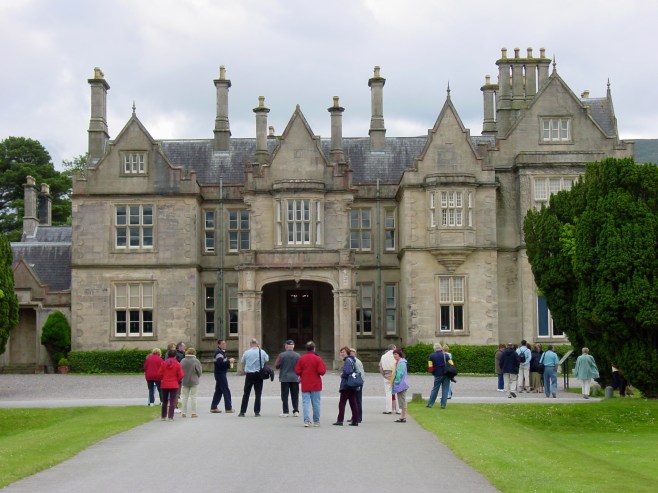
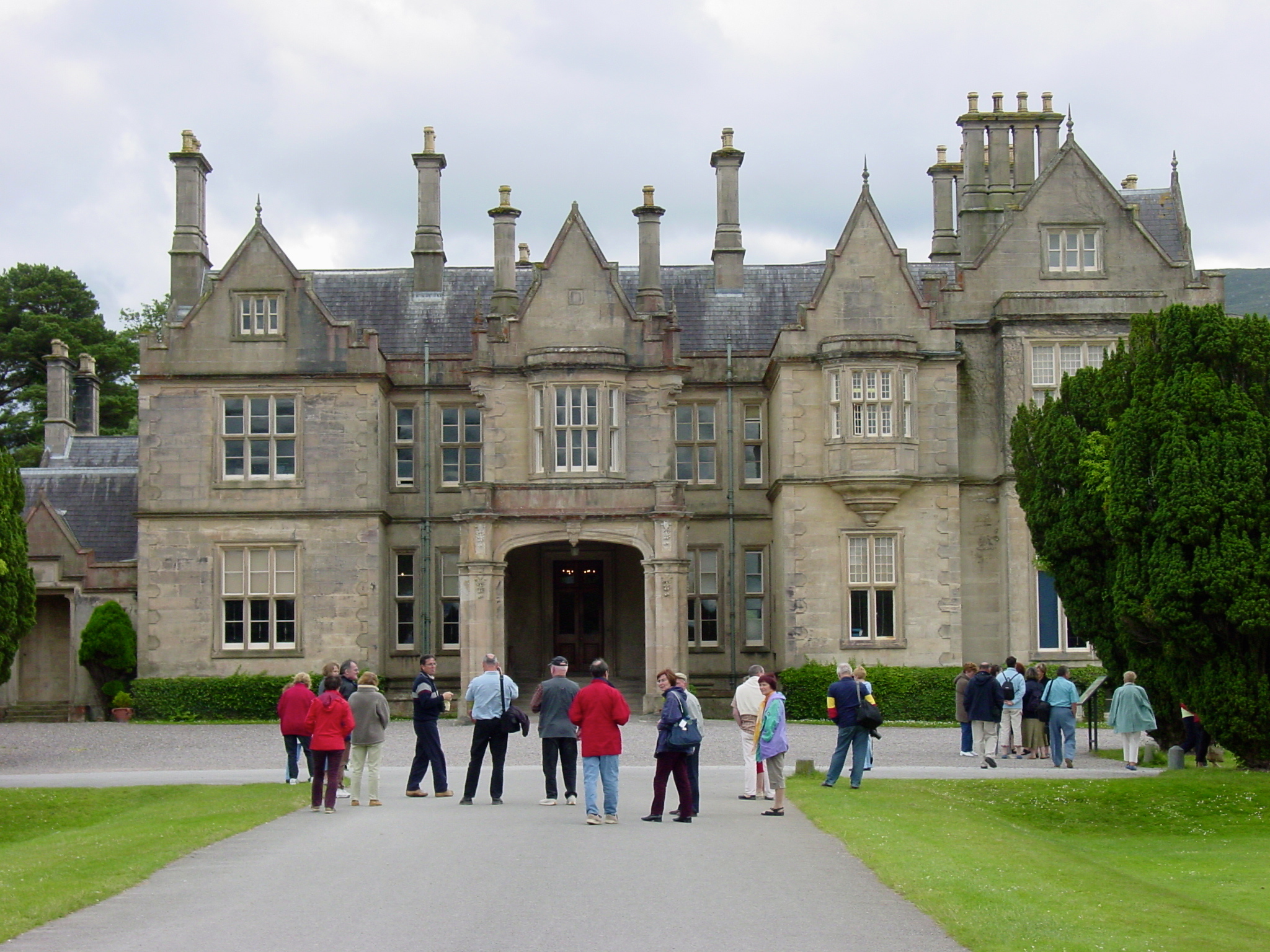
Muckross House

Muckross House

Muckcross House Garden

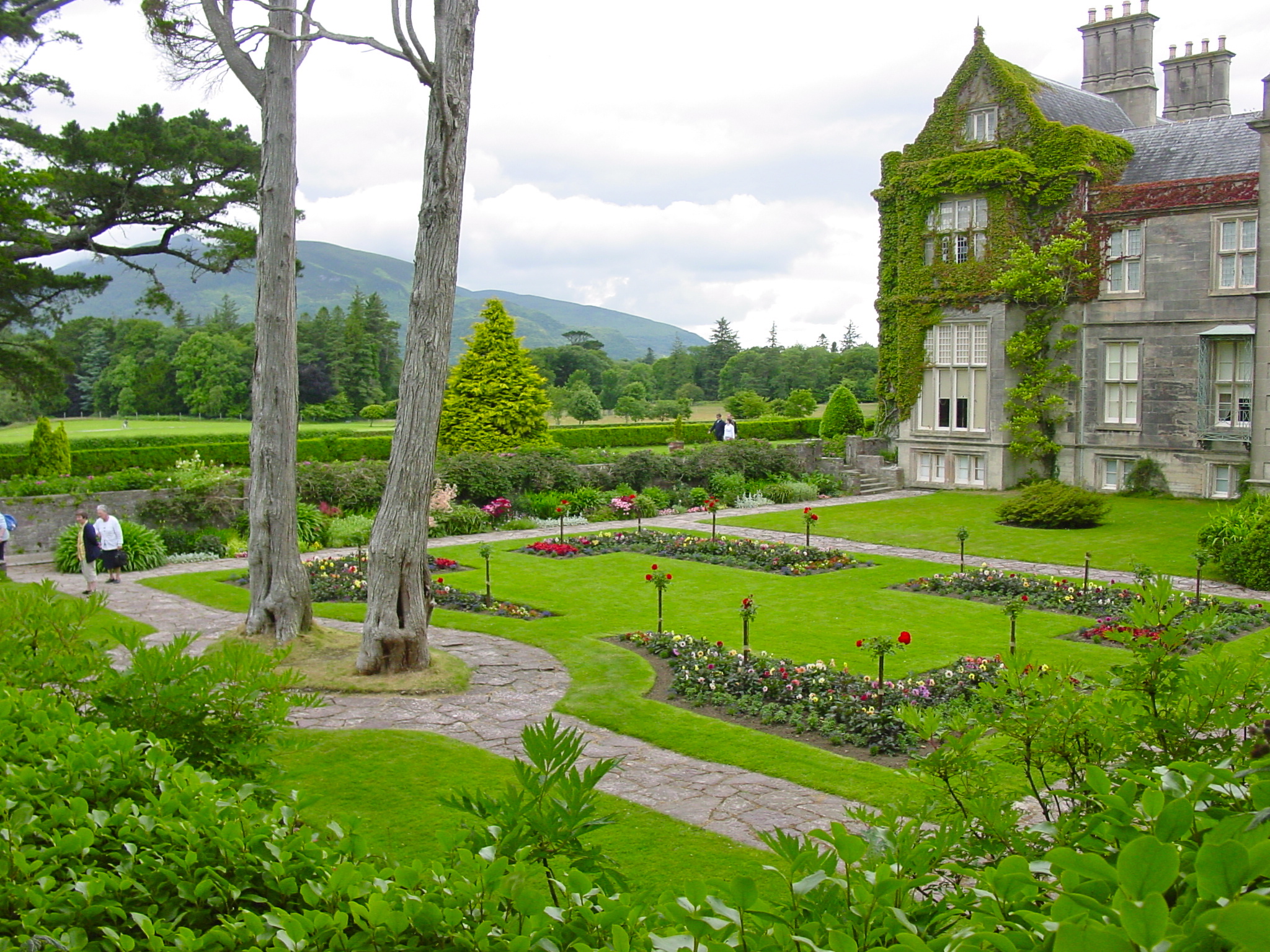
Our last stop is the Muckross House, located on the small Muckross Penisula, located between Muckross Lake and Lough Leanne. Muckross House is a mansion built in 1843 for Henry Arthur Herbert and his wife, watercolorist Mary Balfour Herbert. With sixty-five rooms, expansive improvements were made in the late 1850’s in preparation of the visit of Queen Victoria in 1861. It is said that these improvements for the queen’s visit resulted in financial difficulties for the Herberts’ resulting in the sale of the estate in 1899 to Arthur Guinness, who wanted to preserve the dramatic landscape. In 1911, the estate was sold to William Bowers Bourn, an American mining magnate. In 1932, Muckross House and the 11,000 acre estate was presented to the Irish nation, and became the first National Park in the Republic of Ireland and formed the basis for the present day Kilarney National Park. The house and grounds are beautiful!  Be sure to take the cart ride out to the falls!

Last, but not least, I want to mention my favorite author, Maeve Binchy.  I picked up my first “Maeve” book in an English bookstore in Quebec, Canada, mostly because I thought she had the most unusual name. I went on to read every book I could find.  A novelist, playwright, short story writer, columnist, and speaker, she is known for her humorous take on small-town life in Ireland and her descriptive characters. I am inspired by her. Her novels have been translated in 37 languages and sold more than 40 million copies worldwide. She finished third in a 2000 poll for World Book Day. Binchy was raised Catholic and attended convent schools, but a trip to Israel affected her life and her career.  To quote Maeve.

“In 1963, I worked in a Jewish school in Dublin, teaching French with an Irish accent to kids, primarily Lithuanians. The parents there gave me a trip to Israel as a present. I had no money, so I went and worked in a kibbutz– plucking chickens, picking oranges. My parents were very nervous; here I was going out to the Middle East by myself. I wrote to them regularly, telling them about the kibbutz. My father and mother sent my letters to a newspaper, which published them. So I thought, It’s not so hard to be a writer. Just write a letter home. After that, I started writing other travel articles.”

Maeve went on to write and write. I love all her books, but I re-read every year, The Lilac Bus and Evening Class. My inspiration, is her book, the Maeve Binchy Writer’s Club, words of encouragement in letters from Maeve. To read about the Irish culture, Maeve Binchy, is the author for you! Sadly, Maeve passed in 2012 and is missed by readers everywhere.

For more information about Beach Cove B&B see: http://www.stayatbeachcove.com

For more information about the Skellig Chocolate Factory see: http://www.skelligschocolate.com

For more information about Muchross House see:http://www.muckross-house.ie

For Information about Maeve Binchy see:http://www.maevebinchy.com

From Cong to Dingle

This is Part III in a series called Going Green to Ireland. We are driving along the western coast of Ireland.

Saying goodbye to Ashford Castle today we are driving to Kinvara, where we will be staying in the Cois Cuain B&B. Mary Walsh greets us into her three bedroom cottage with  a garden overlooking the square and harbor close to the Dunguaire Castle, a 16th-century tower house on the southeastern shore of Galway Bay.

Dunguaire Castle

Dunguaire Castle

Dunguaire Castle is one of the most visited castles in Ireland. Tonight we will be attending a medieval feast of food, folk music and storytelling at the castle. Greeted by the butler, who gives us a brief history of the castle and a goblet of mead, we are led up the stairs to the Banquet Hall and seated on benches at long oak tables. I have learned another thing here this evening, even in the summer it is very cold in a stone castle. Bundle up!   We enjoyed our evening meeting other travelers and participating in the feast.

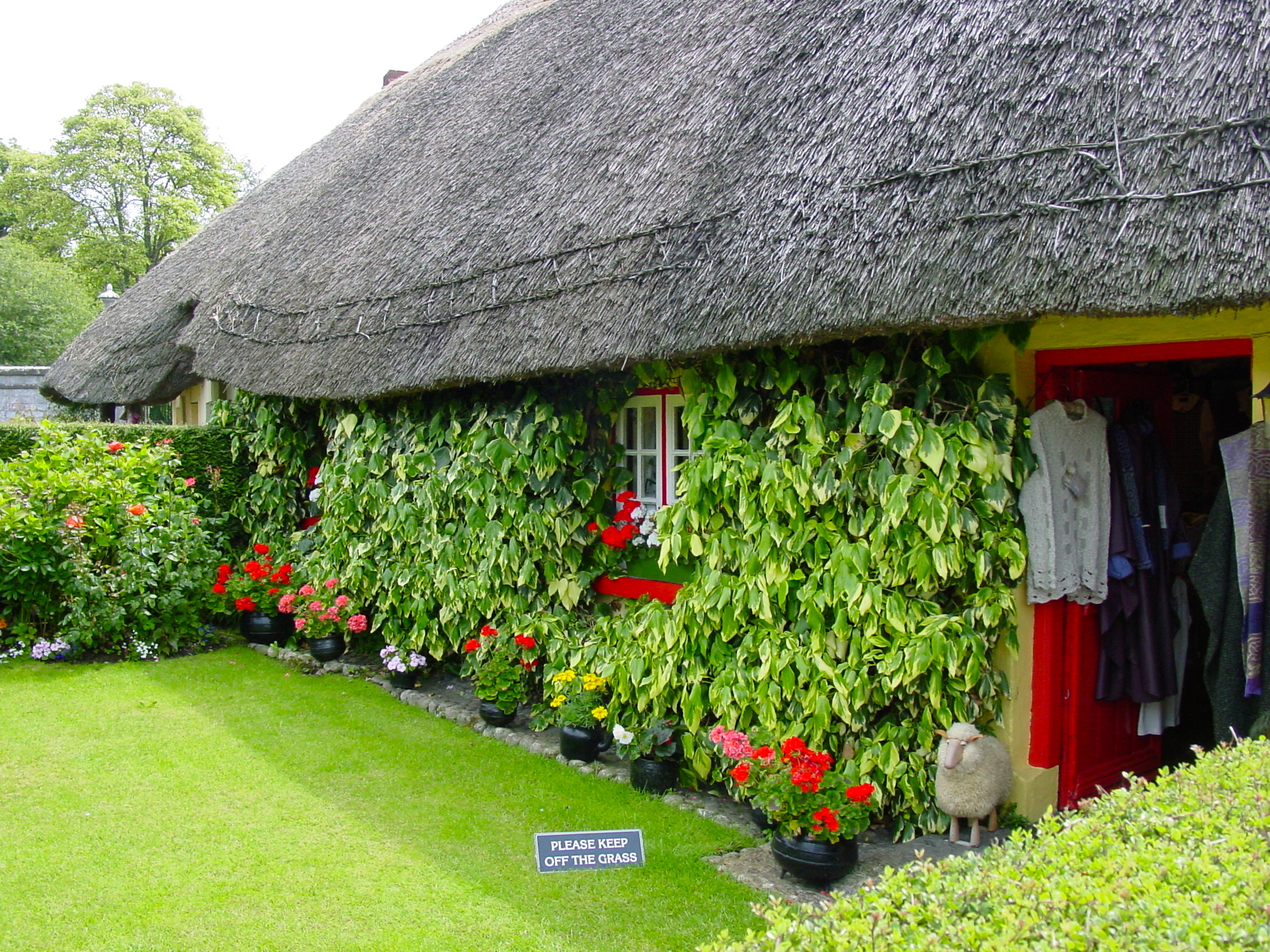
The next day, after Mary’s terrific breakfast, we head to the Cliffs of Moher. Facing gale winds and a torrential downpour we walk to the edge of the cliffs. On the way back to the car we stop to have hot chocolate in the tiny cliff restaurant to warm up!  Making our way to Dingle we enjoy the peacefulness of the drive, just looking at the scenery; the potato fields separated by stone walls and fields of cows. Going through Adare we stop and look in the old thatched cottages that are now shops.

Adare  Thatched Cottages

Adare Thatched Cottages

Adare Gift Shop

Adare Gift Shop

Rainbow in Dingle

Rainbow in Dingle

Dingle, is a fishing village on the mountainous finger of land that juts into the Atlantic Ocean that has supported various tribes and populations for almost 6,000 years. Because of the remote location and lack of specialized agriculture there is a large preservation of over 2,000 monuments from the Mesolithic Age onward. On our first full day in Dingle we signed up for a tour with Sciuird Archaeological Tours. (Screw-id)  The tour is offered by Tim Collins (a retired Dingle police officer) and Michael, his son. A group of six ventured off in his van. We were transported down tiny farm roads, (formerly cow paths) and over hedges and ridges to view mysterious stone tombs, sweeping seasides and long forgotten castles, all while Tim offered a commentary on the history of Dingle.

Dingle Loop

Dingle Loop

Puffin

Puffin

Two tours are offered: west to Gallus Oratory and east to Minard Castle.  We enjoyed both tours. Returning to Dingle, after the tours, we were delighted to find that St Mary’s Church was having a folk music concert that evening. Enthusiastic guests were toe-taping to Irish jigs and teary eyed with the slow haunting melodies. Afterwards, everyone to the pub!

For more information about the Cois Cuain B&B see: Several listings are on the internet under Ireland B&B’s

For more information about the Dunguaire Castle see: Several listings are on the internet under Dunguaire Castle.

For more information on the Sciuird Archaeological Tours see: http://www.dingle-peninsula.ie/tours.html

Be sure to watch my video to explore Ireland!

The King of Cong

A Look at Ashford Castle

A Look at Ashford Castle

This is Part II in the Going Green to Ireland series.  Today we have made our way to Cong!

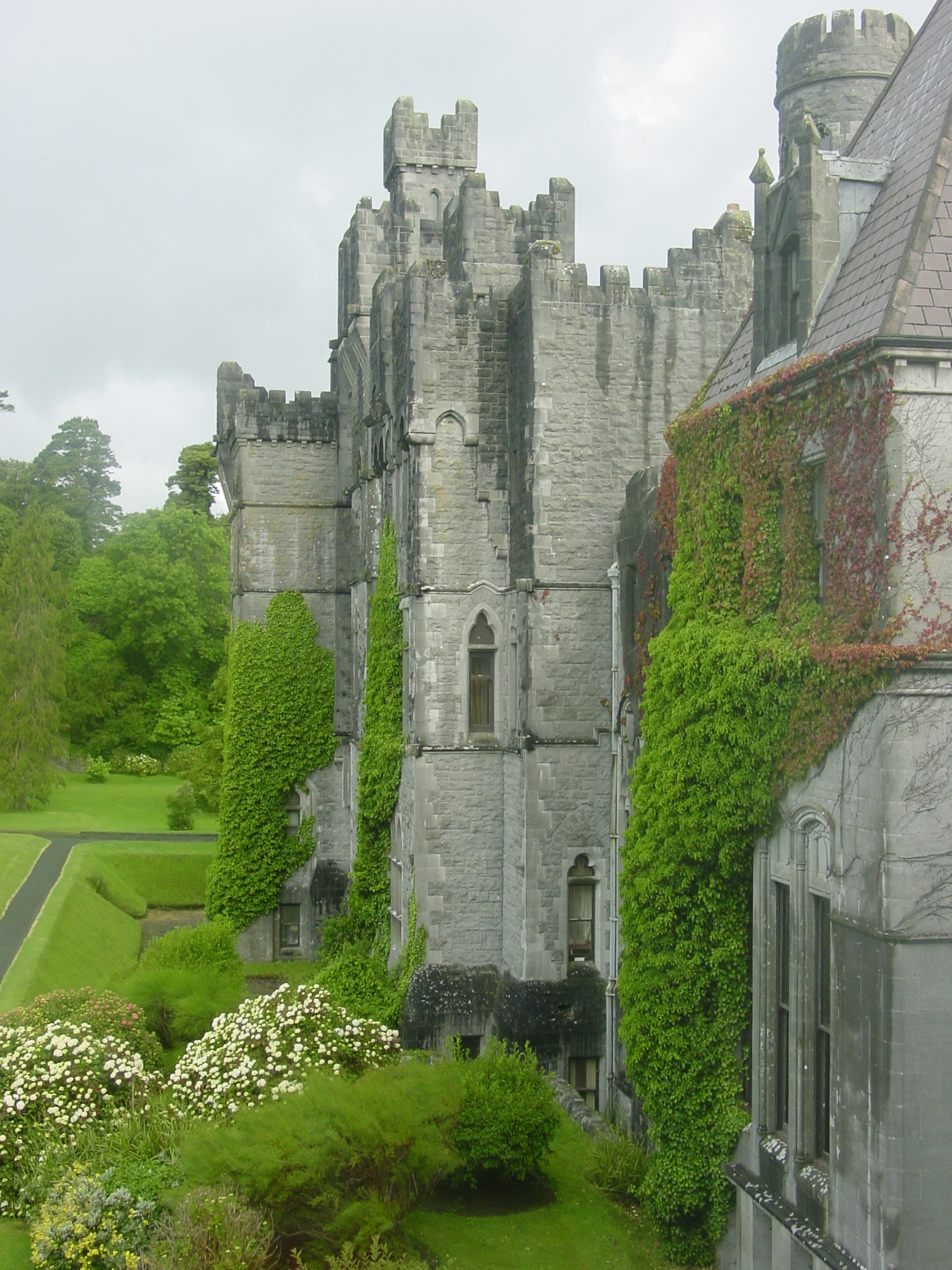
Ashford Castle is a medieval castle built in 1228 by the Anglo-Norman de Burgo family. Over the centuries the castle has been expanded and turned into a five star luxury hotel near Cong on the Mayo/Galway border in Ireland, on the shore of Lake Corrib. In 2012 the hotel was voted the best resort in Ireland and the third best in Europe by Condé Nast Traveler. We arrived at the expansive wrought gates and drove down the long driveway to the castle at early dusk. In the shadows I felt just like a maiden returning to the manor. We were shown to a beautiful corner room of the hotel with views of the garden and Lake Carrib.

King George Ding Room at Ashford Castle

King George Dining Room at Ashford Castle

The dining room was our next stop, just like something out of Downton Abbey, but on a much larger scale. It was tuxedos and white gloves for all the servers. Later, we topped off the evening in the castle pub, where the singing was about to begin. The Irish music was so captivating, and I had had just enough drink.  The result: I was coerced to go onstage and sing. It was so much fun! However, there was a group in the rear of the pub who would rather talk than listen and/or sing. Before I got up for the sing-along with the entertainer, he had warned the inattentive group to keep it down. We began our song, reading the lyrics from a tele-prompter. Of course he had a beautiful voice with an Irish brogue, and I was happily trying to sing along and not make a fool of myself.  During one of our subsequent songs, suddenly the entertainer stopped singing and the music stopped. He determined the guests at the rear table were not paying any attention and asked them to leave. So that was my stage debut and my last. But, it was great fun while it lasted!

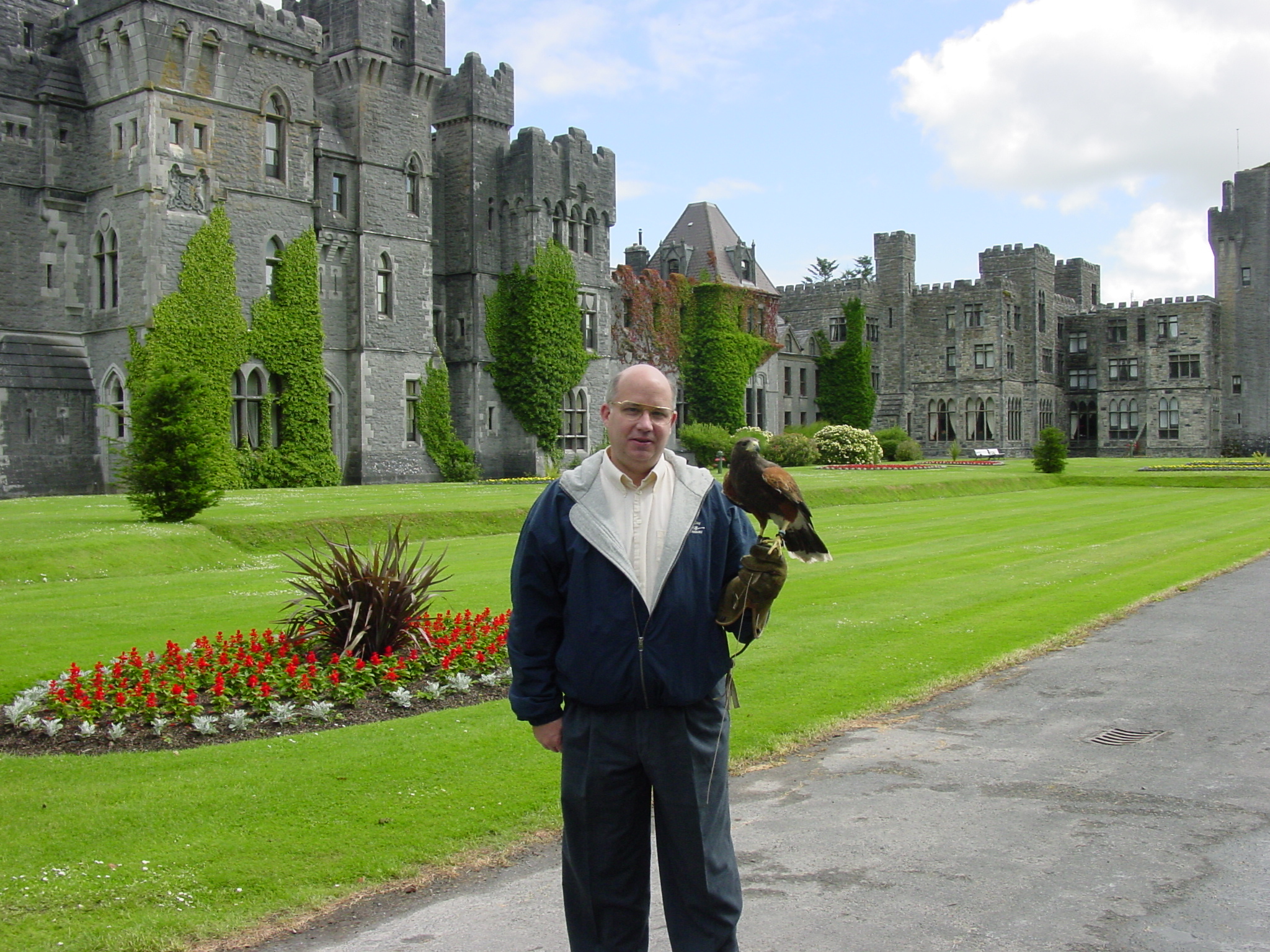
Guest with Harris Hawk

Guest with Harris Hawk

The next day we toured the Falconry School training area where falconry classes are taught at Ashford Castle, the oldest established falconry school in Ireland. A young American girl led the class and I watched and some participated in a session with a falcon and an owl, known as the Hawk Walk. Falconry is an ancient art and said to be the oldest sport in the world. It was used as a way to catch food for yourself and your family.  Harris Hawks, owls and falcons are brought from their cages and within minutes, with the bird sitting on your gloved hand you are ready for the walk and his performance. Our teacher explains the birds’ exceptional eyesight, speed and agility and how the bird will follow you from tree to tree and at the end return to your gloved hand. Everyone truly enjoyed the falconry class.

The Cong River

The Cong River 

 Later in the day we walked more of the grounds of Ashford Castle. I was particularly interested in seeing the cottages and land marks filmed in the 1951 movie, The Quiet Man, with John Wayne and Maureen O’Hara. The grounds of Ashford Castle and nearby village of Cong, formed the backdrop for much of the action in the film. It’s March, time to watch The Quiet Man and listen to Bing!

For information about Ashford Castle see:http://www.ashford.ie/irish-castles.html

The Wow in Wengen

Wengen

Wengen

This is my final posting of my favorite small villages in Switzerland. Interlaken, between Lake Thun and Lake Brienz, is touristy with lots of diverse restaurants and hotels.  Mürren sits high on a ledge and overlooks the Lauterbrunnen Valley.  Traffic-free, it is quaint and picturesque with shops, eateries and hotels.  Gimmelwald is traffic-free,  the smallest of the villages and one of a kind. There are great walks and hikes from Gimmelwald, which makes it very popular with the hiking crowd. But, my favorite of all the villages is Wengen.  Wengen, population 1,300, swells to 5,000 in the summer months and 10,000 in the winter. It too is traffic-free and to get there from Interlaken you take the train to Lauterbrunnen, and switch trains to go further to Wengen. Arriving on the train we see women getting off and unloading large trolleys of groceries and staples to pull up to the chalets and hotels.

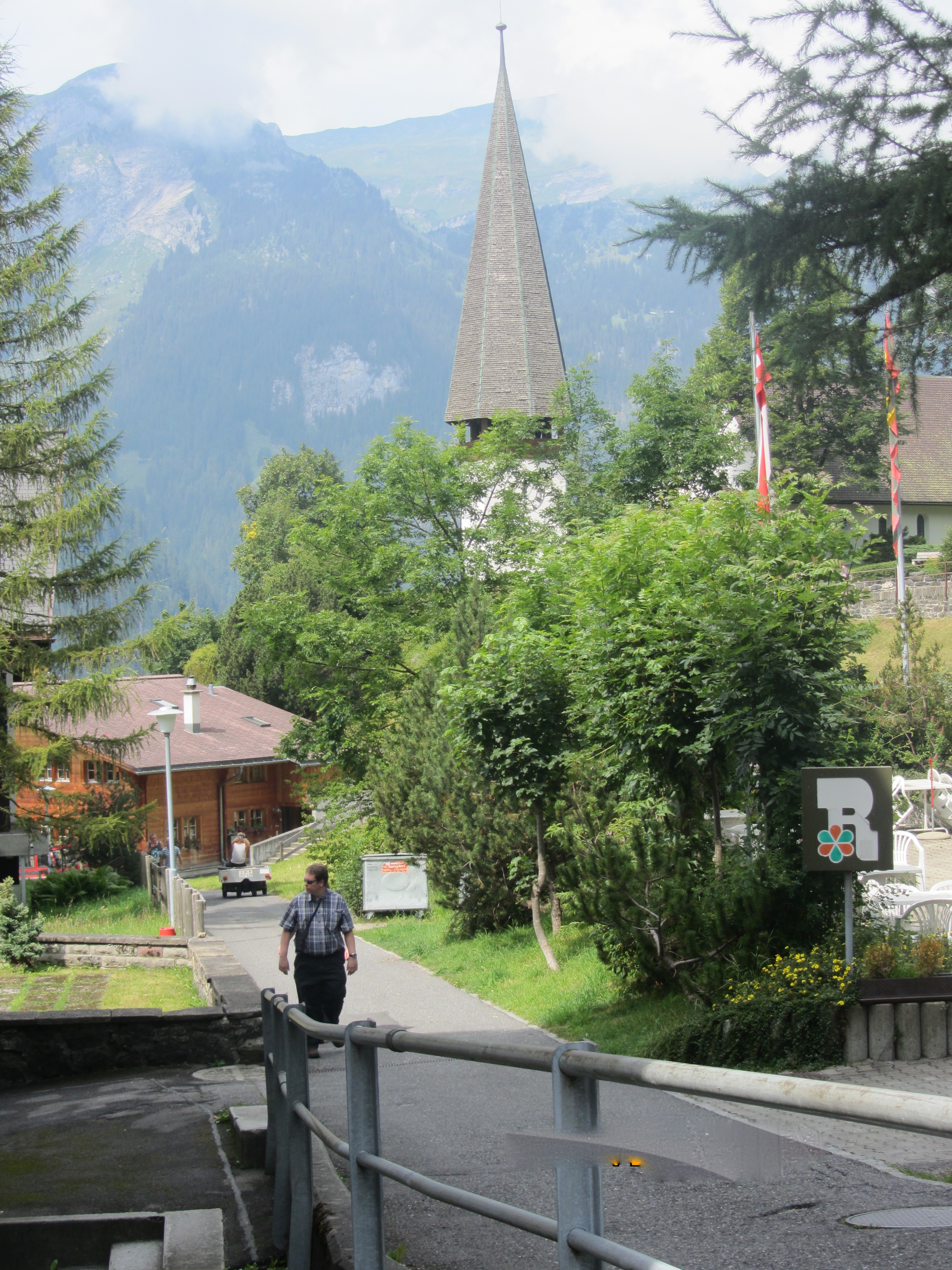
The Walk into Wengen

The Walk into Wengen

There is a small grocery shop in Wengen, but for supplies it must be easier to cart them from Interlaken.  I took a tour of the Victoria-Lauberhorn Hotel and Spa.

The Victoria-Lauberhorn Hotel and Spa

The Victoria-Lauberhorn Hotel and Spa

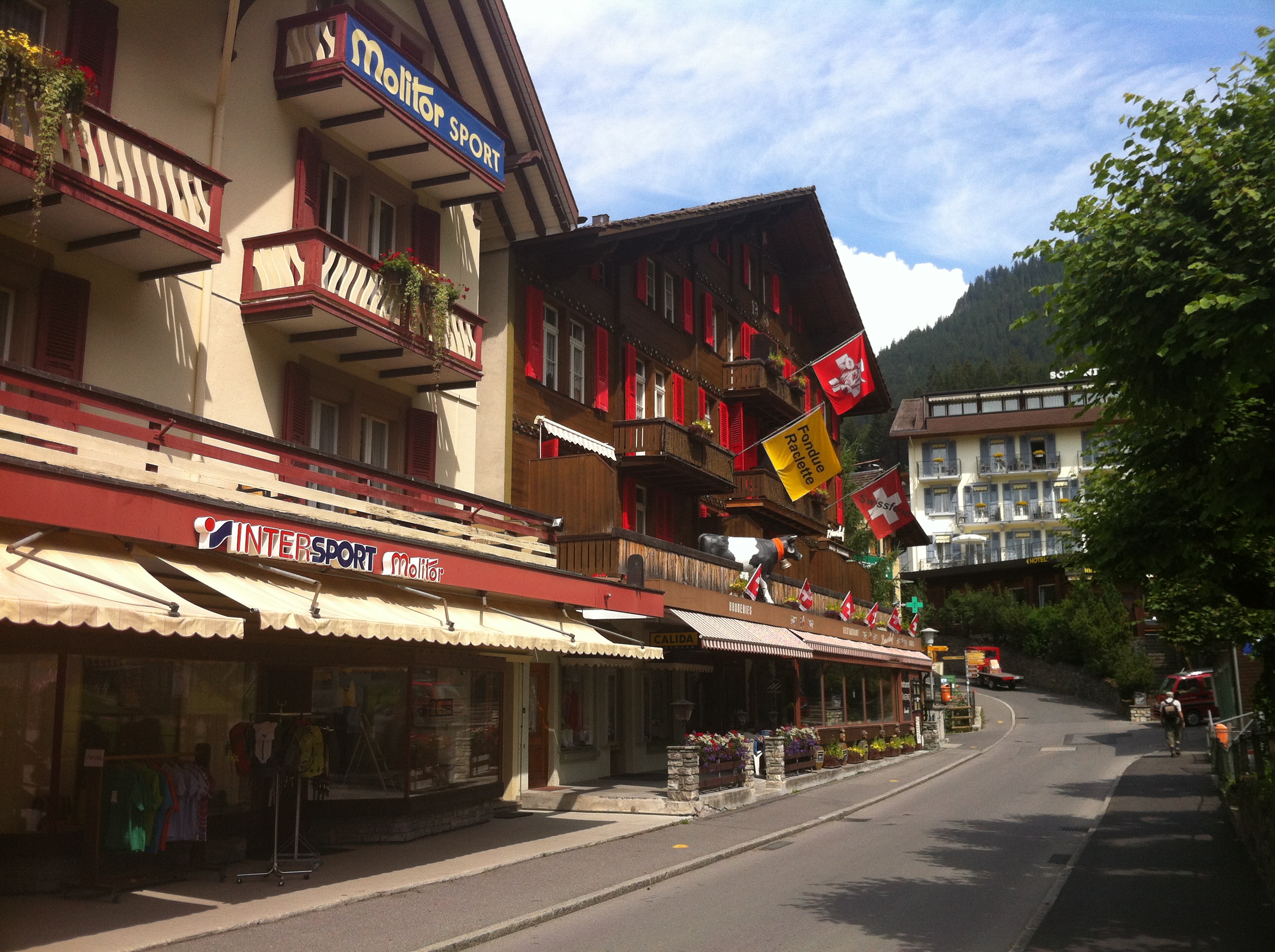
The rooms at the Victoria-Lauberhorn are on the small side, but have a fantastic view of the mountains and the spa facilities were relaxing and calming. There is a one street shopping area, with fine specialty shops for the nicer souvenirs.

Main Shopping Area of Wengen

Main Shopping Area of Wengen

One shop features, crafted in Switzerland gifts only, and I bought a handmade coo-coo clock here and had it shipped home. There is also a very nice jewelry shop.

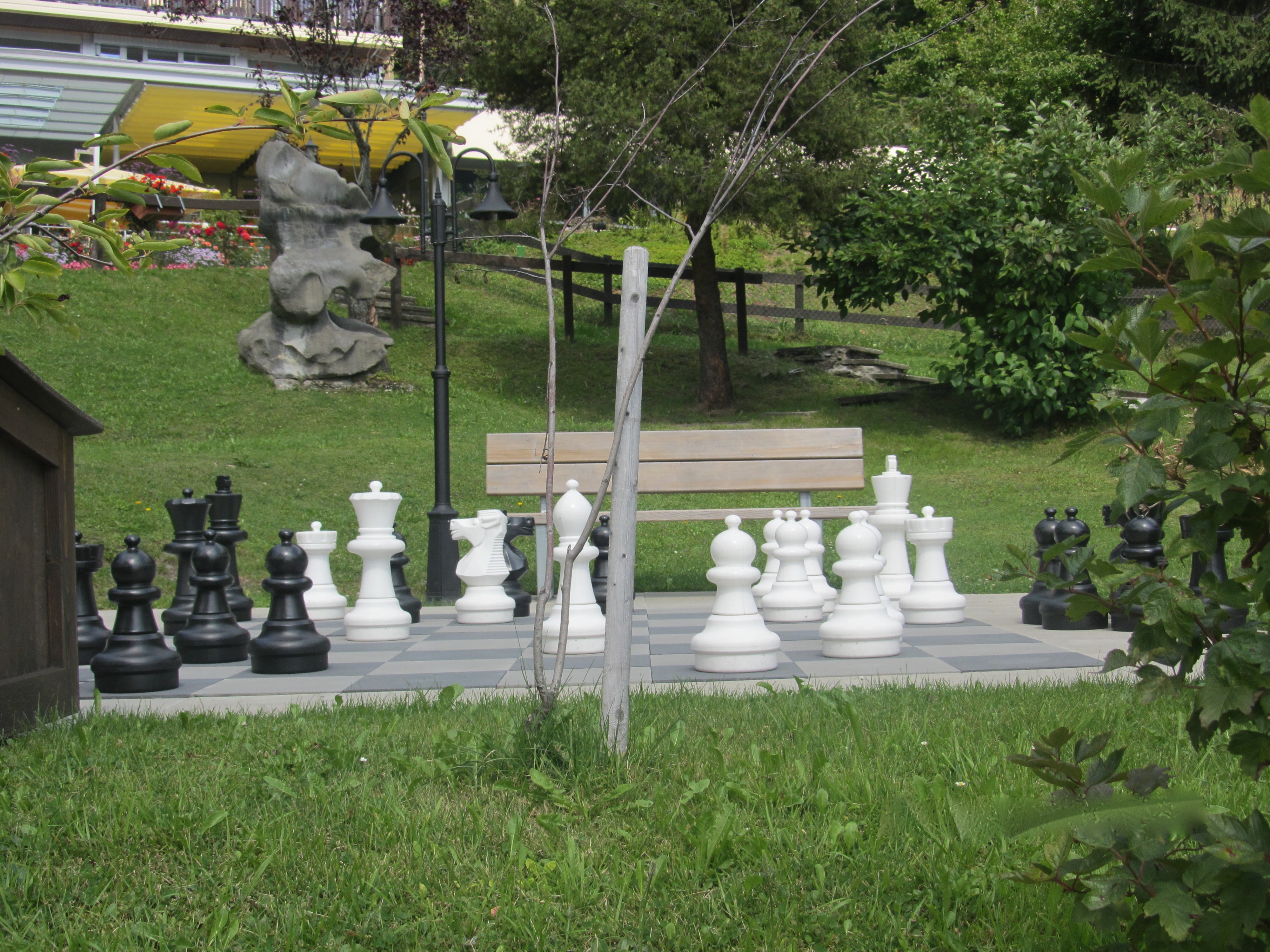
The Chess Pieces

The Chess Pieces

Walking through town there are large parks and huge chess sets. Benches are placed along side the sets so you watch how the match is going. There are also tennis courts and a pool in the upper park area past St Bernards English Church. The priest is available only in the summer months, since it is a rotating ministry.  He was on sabbatical from the UK, but said the church was supported by the parish and held services most of the year, but sometimes without the priest.  It was the same for the local Catholic Church as well. My highlight was the conversation I carried on with a German speaking woman, who invited me into her beautiful abundant flower garden. We got along just fine, mostly pointing and smiling.

Wengen Flowers

Wengen Flowers

The loop walk through Wengen is just long enough to stretch your legs, mingle with the locals and enjoy every minute of your stay. My choice for a vacation in Switzerland would be Wengen.  It is perfect!  Be sure to watch the video to get an idea how beautiful it truly is!

For more information on the Victoria Lauberhorn Hotel and Spa see: http://www.hotel-victoria-lauberhorn.ch

Around and Down to Gimmelwald

 Chalet in Gimmelwald

An Alp

I’ve decided smaller is better. The smaller a village is the better I like it.  Gimmelwald, population 100, is ideal. We are walking the switchback paved path from Mürren to Gimmelwald and it is a glorious day! We part from the upper lane to the lower lane at the end of Mürren and make our way through the burbs (the last chalets before the smaller path to Gimmelwald). Looking down, down, down, Gimmelwald is just a speck at the bottom, but only a 30 minute walk, all downhill. The only people we pass are the bikers (bless their hearts) that are biking the trail up.  Good for them!  Meadows are filled with beautiful summer blooms and the cows are busy grazing.  It takes me a few minutes to get Bluebell to look up for a picture.  That grass must really be good! We hear the bells on the goats long before we see them and when we do they are in a hurry to move on. We walk a few hundred feet, turn back, walk a few hundred feet turn back.  This is the way to Gimmelwald.

The Walk to Gimmelwald

The Walk to Gimmelwald

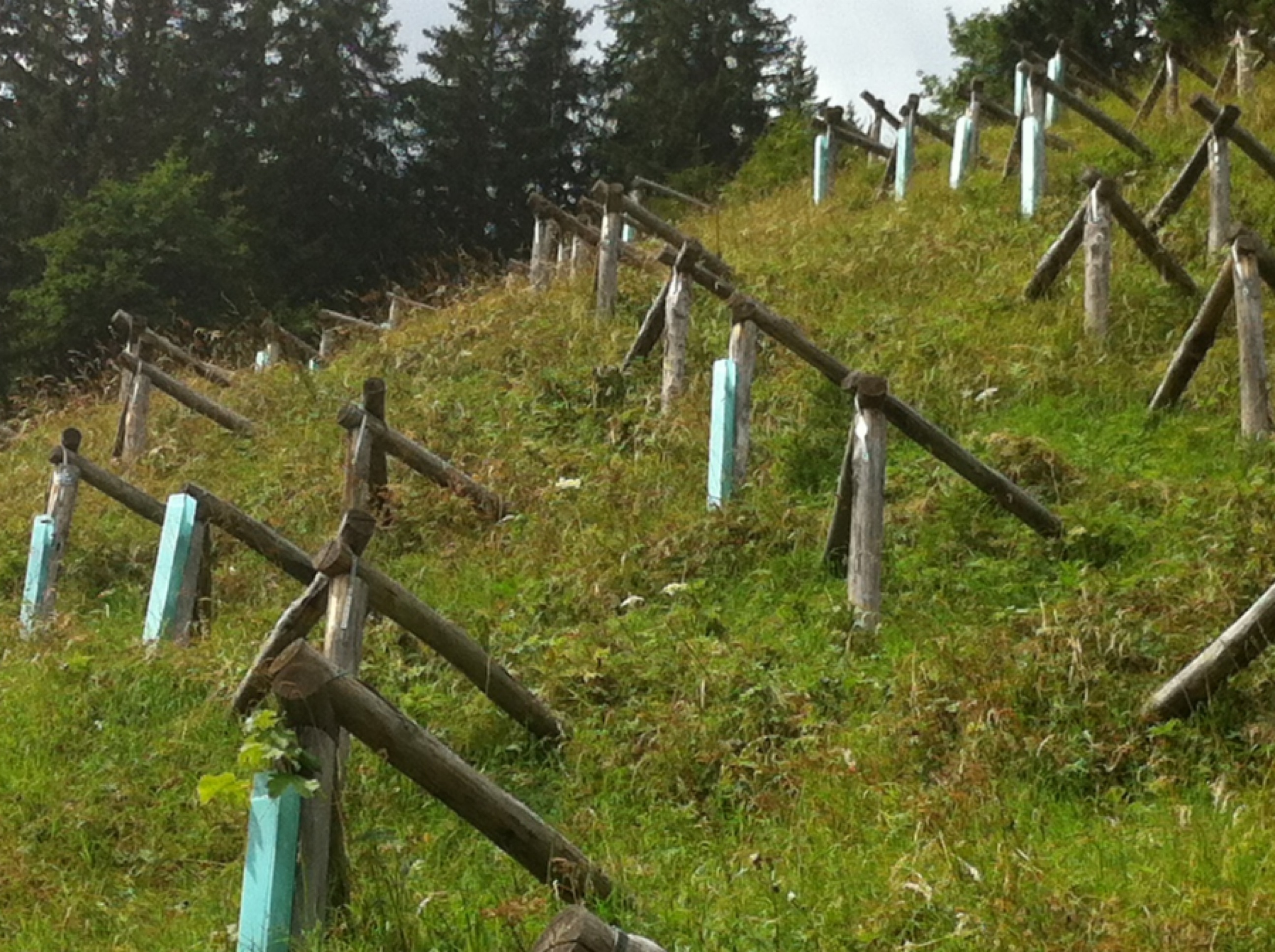
Saved from developers, who wanted to turn Gimmelwald into a village of 1000, the village was determined to save itself by declaring the village was in an avalanche zone. On the hills we see the angled wooden sticks designed to help prevent the snow from barreling down the mountain.

The Avalange Sticks

The Avalanche Sticks

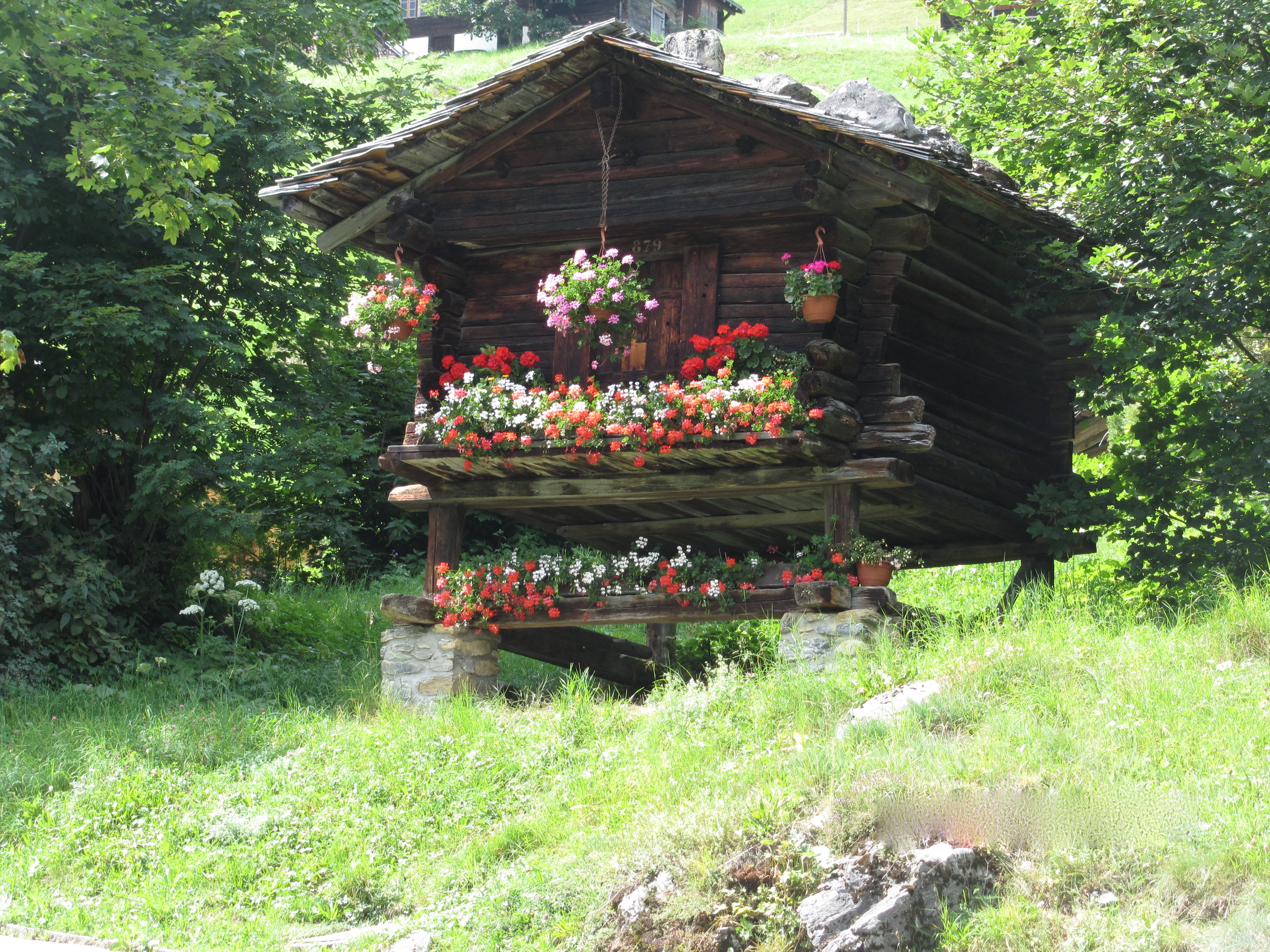
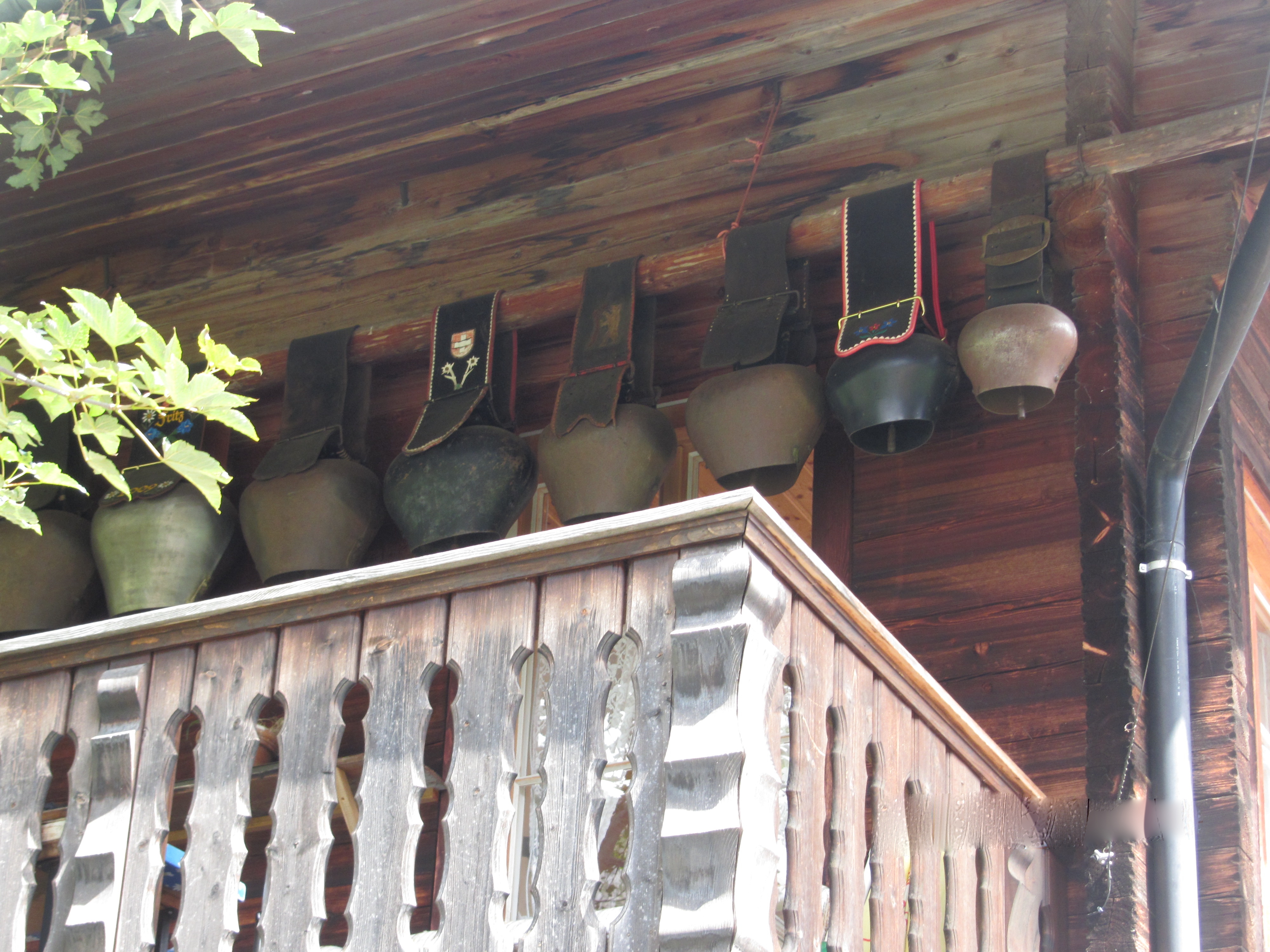
They had to do something in order to get the avalanche zone building code! The code would keep developers out. The village is a community of farmers who make hay while the sun shines and cares for their cows. In mid-summer the farmer straps elaborate ceremonial bells on the cows and takes them up to a hut at high elevations. When the cows arrive at their summer home the bells are removed and hung under the eaves of the hut, called alps.

The Cow Bells

The Cow Bells

The farmer hires a team of cheese makers, mostly students and city slickers who want to spend a summer in the mountains, to work at each alp. Now there’s a summer job for you! It’s up at 5am to milk, take the cows to pasture, make cheese, and then milk again in the evening. In the summer all milk is made into cheese and in the winter the fresh milk is sold as milk. While the cows are higher up on the mountain the farmers are busy making hay. As the cows come down the mountain in late summer they stop and eat the hay that has been stored up in small huts along the path by the farmer, who has spent the summer preparing the hay for them.

The Cheese Hut

The Cheese Hut

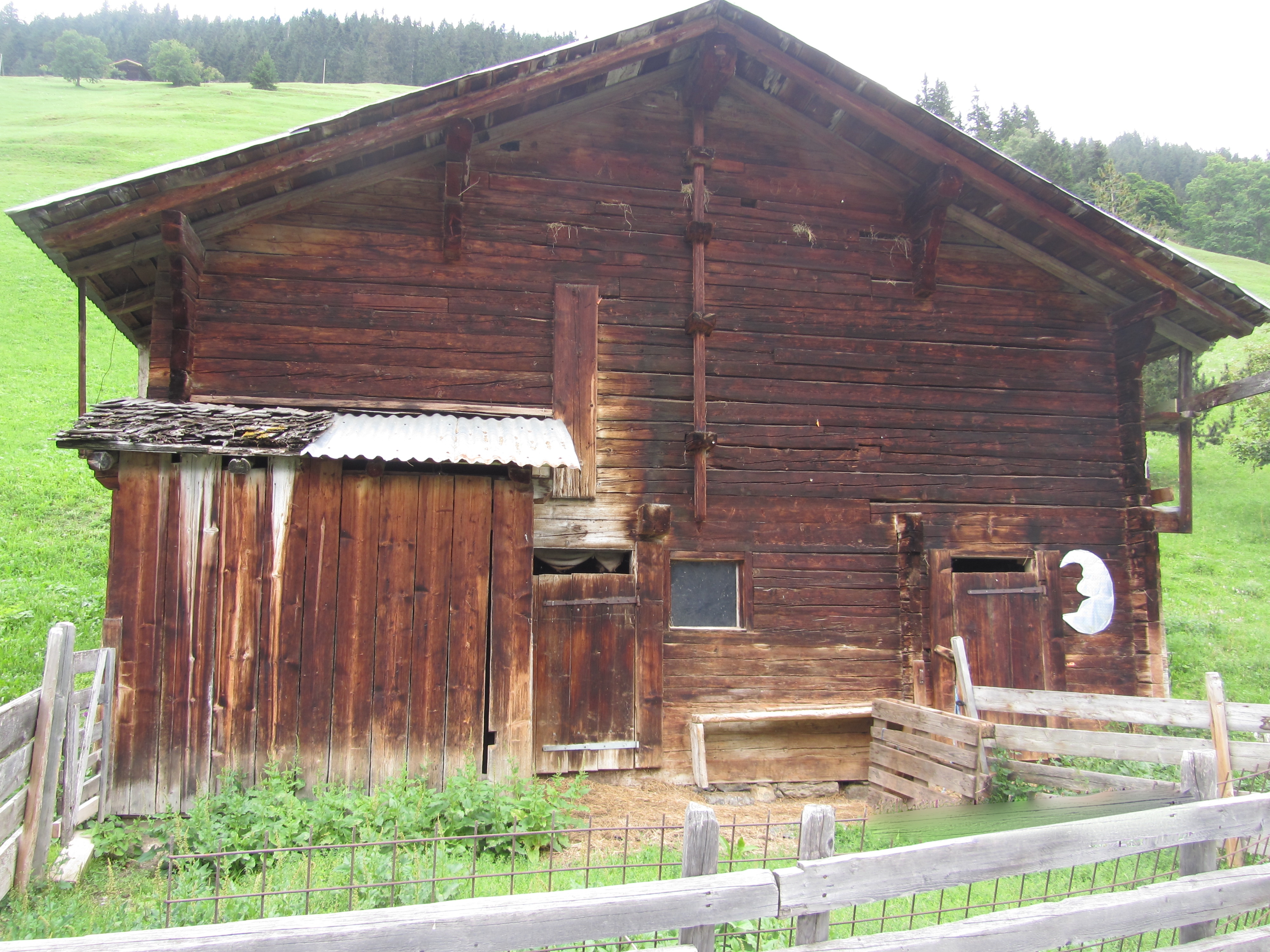
The first lodging you come to when walking down from Mürren is the Hotel Mittaghorn, ran by Walter Mittler. The hotel features a loft of 10 beds, several sinks, one shower and a fire ladder out the back window. This location would be great for a group of hard core hikers. Dinner consists of salad, main course and dessert served at 19:30 by reservation only. If this place seems to0 frilly for you the next stop is the Schlaf im Stroh, (Sleep in Straw) an actual barn. After the cows head for higher ground in the summer the von Allman family hoses down the barn and fills it with straw. Blankets are free, but bring your own sleeping bag. They fluff up the hay each night before bed. The fee includes breakfast, a modern bathroom and showers.  The kids would love it!

Schlaf im Stroh

Schlaf im Stroh

Gimmelwald has a strict building code. All shutters must be natural, green or white. The main shopping area, one tiny room of farmers goods, operates on the honor system. An announcement board reveals the news; one side for tourists and the other for the locals.

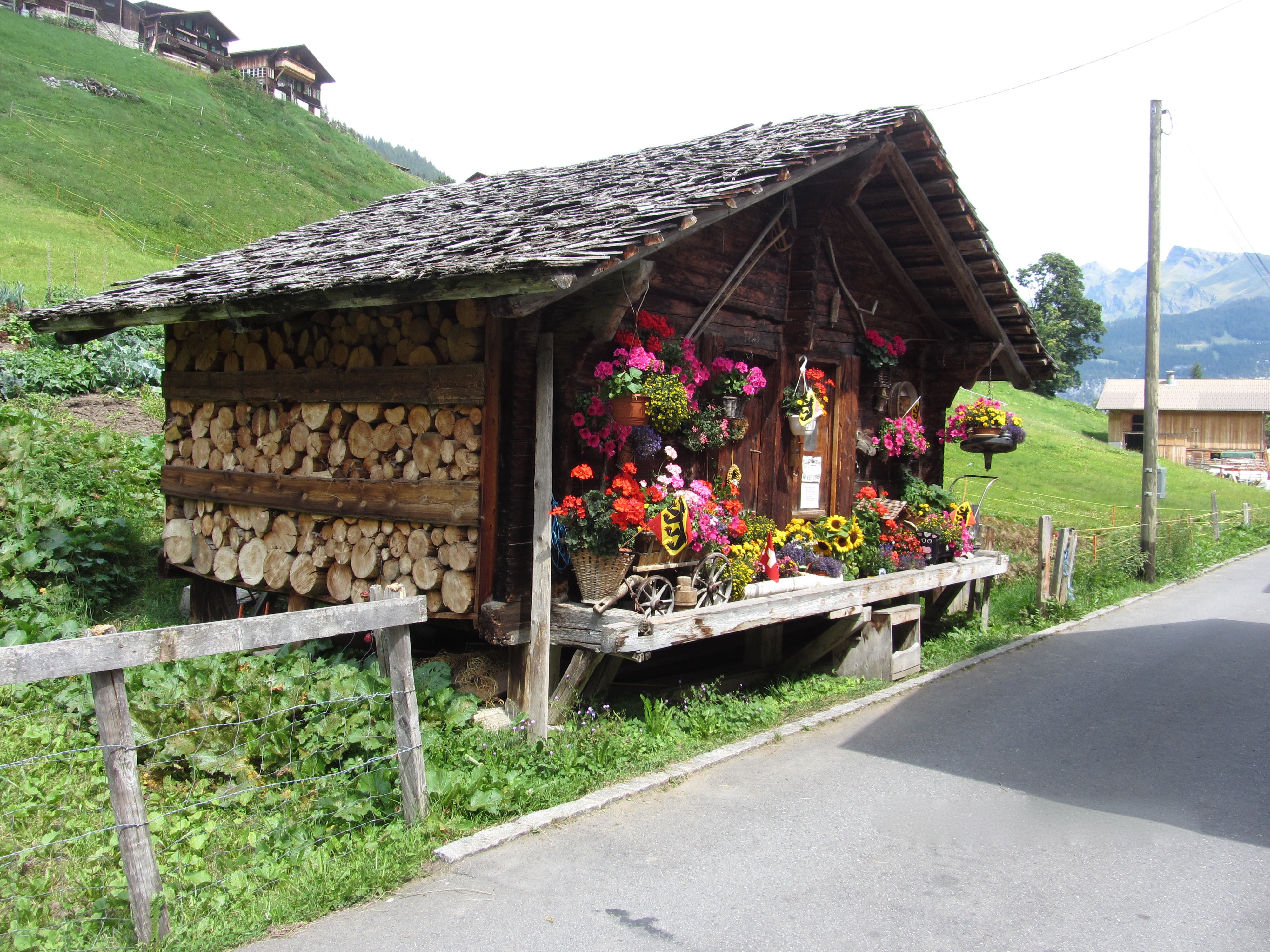
Villagers heat their homes with wood, so every house is surrounded in cut logs, since the wood needs to be aged a couple of years to burn well. There are also covered stacks of wood all through the village.

Gimmelwald House Surrounded by Cut Wood

Gimmelwald House Surrounded by Cut Wood

Next we stop at the house of the school teachers, Olle and Maria Eggimann. They rent out two rooms in their house, the most comfortable place in town. We ring a bell and Olle comes down the stairs to a small room called the Lilliput Shop, where we buy sugar coated almonds.

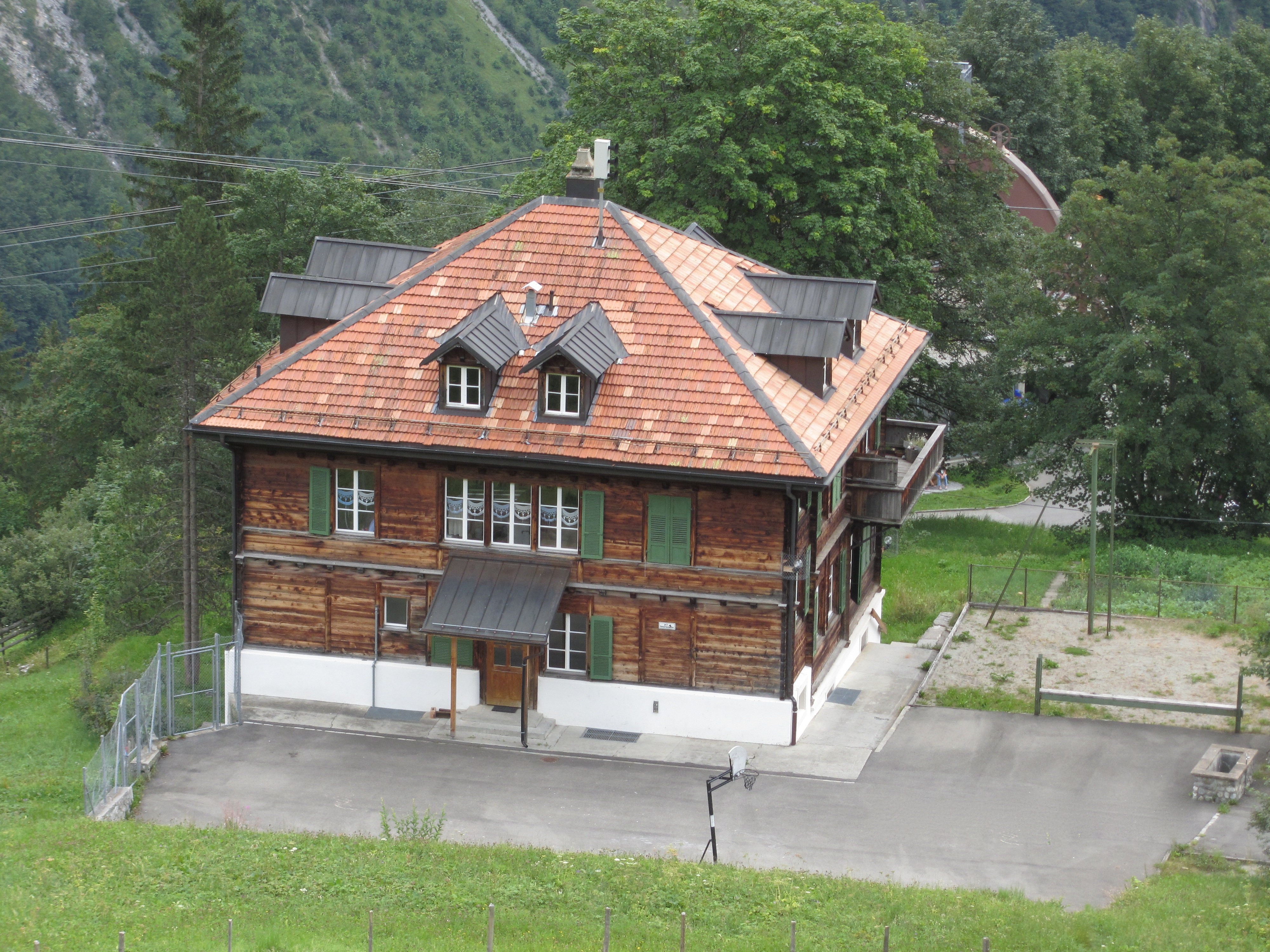
The Alpenrose is the old school house with the big cow bells hanging under the eaves. The new school house is a huge building. There is a computer for each of its 17 students, two teachers, and a large playground outside.

The New Schoolhouse

The New Schoolhouse

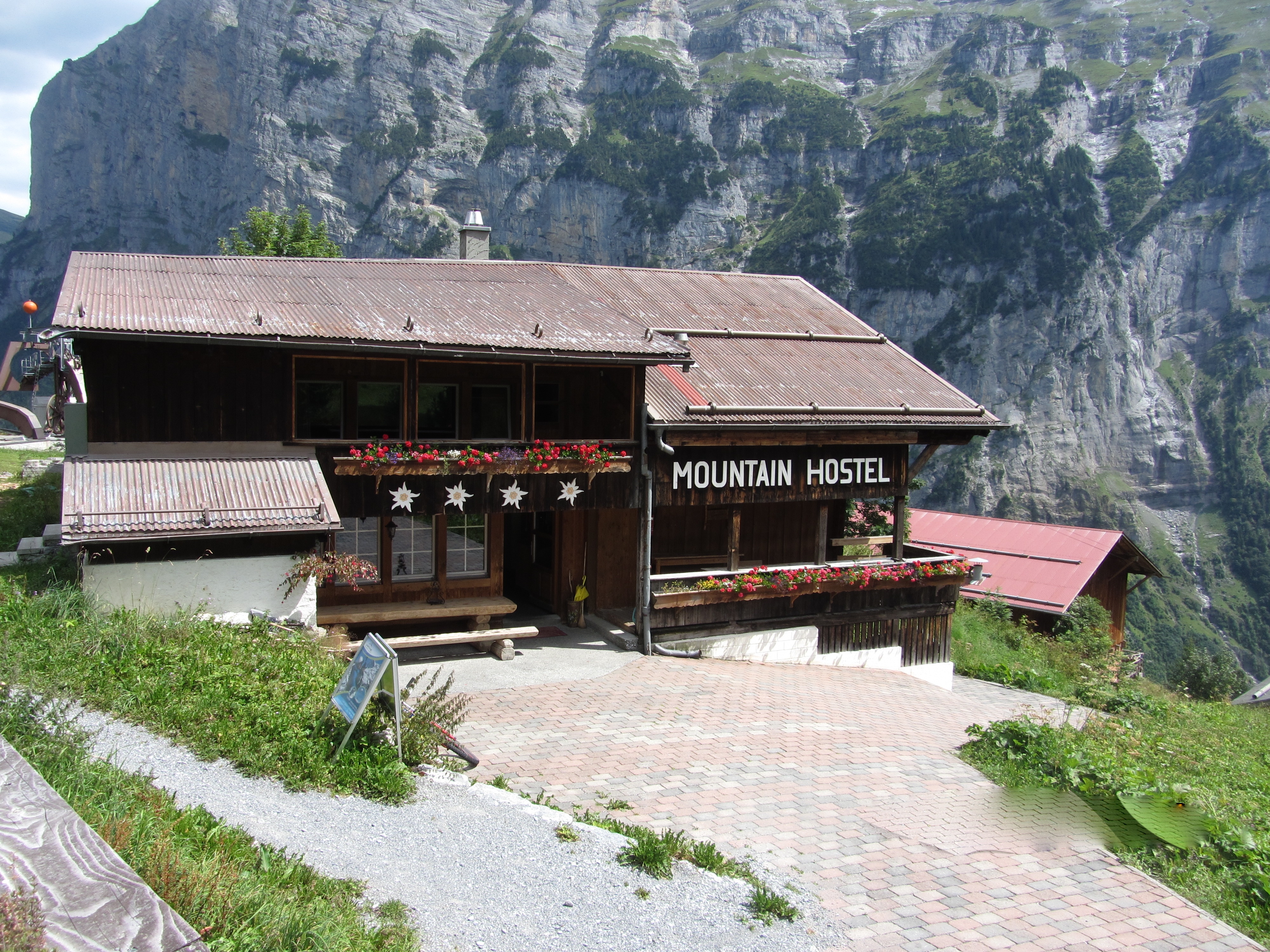
The Mountain Hostel is the center of activity in the village. With 50 dorm beds, a self-serve kitchen, a mini grocery, and pool table, it is lively with the college age crowd.

Mountain Hostel

Mountain Hostel

The Pension Restaurant has 13 basic rooms to let and Gimmelwald’s only restaurant. With breathtaking views it is right next to the gondola station. We stop and enjoy a plentiful lunch.

Pension Gimmelwald

Pension Gimmelwald

We end our day in Gimmelwald with a gondola ride (the only way in or out of town other than walking down from Mürren) to the valley below where we catch a train back to Interlaken. A day in Gimmelwald is a step back in time. It’s good to know there are still places to be found like this. Definitely, Gimmelwald is my kind of place! Watch my video to get an idea what it is like to walk to Gimmelwald!

For more information about the B&B ran by Olle and Maria Eggimann, email them at oeggimann@bluewin.ch

For information about the Gimmelwald Pension see: http://www.pensiongimmelwald.ch

For information about the Mountain Hostel see: http://www.mountainhostel.com

For the other lodging accommodations show up in the village and talk with them.

Mürren and the Alphorns

Mürren

Mürren

We are at the train station, Interlaken Ost, (East) early this morning to go to Lauterbrunnen. From Lauterbrunnen we take the funicular to Mürren.  Mürren, population 450, is a pleasant alpine resort filled with bakeries, cafés, chalets and no public road access. There are over 2000 beds available here in chalet looking hotels. Perched on a ledge overlooking the Lauterbrunnen Valley and surrounded by mountains (the Eiger, Mönch and the Jungfrau) Mürren is definitely “Heidi” like. Mürren is the highest continually inhabited village in the Canton of Bern. It is recognized by the design of the chalets and the pronunciation of the Mürren dialect.  In 1911 the first British winter tourists arrived. In the village there is no full time doctor, no police officer, and no resident priest or pastor, but keep your eye open for the “Milch Express,” a tiny cart that delivers fresh milk and eggs to the hotels and homes throughout the village. Getting off the train the hikers go in one direction, to the Gondola Station taking skiers and hikers up to the Schilthorn and down to Stechelberg via Gimmelwald, and the Japanese tourists with cameras bigger than they are, head off into another direction, to set up their tripods.  We follow the sound of music, literally. On a flat terrace of earth is a group of musicians providing a concert playing long, long, long horns called Alphorns. How much breath does it take just to blow one of those things? Alphorns, alpenhorns or alpine horns are used by the mountain dwellers for communication or signal instruments, substituting them for the lack of church bells. They are carved from solid softwood either spruce or pine. In former times the alphorn maker would use a bent tree to create the curved shape of the base, but modern woodmakers piece the wood together at the base.  The cup shaped mouthpiece is carved from a solid block of wood and added last to the instrument. The sound is similar to blowing through a long tube, but they do have music designed for the alphorn. After a café we walk to the paved utility road (wide enough for a small tractor with hay) and begin our descent to Gimmelwald.  Be sure to watch the video!  Scenery is fantastic!

The Hills are Alive, but the Town is Touristville

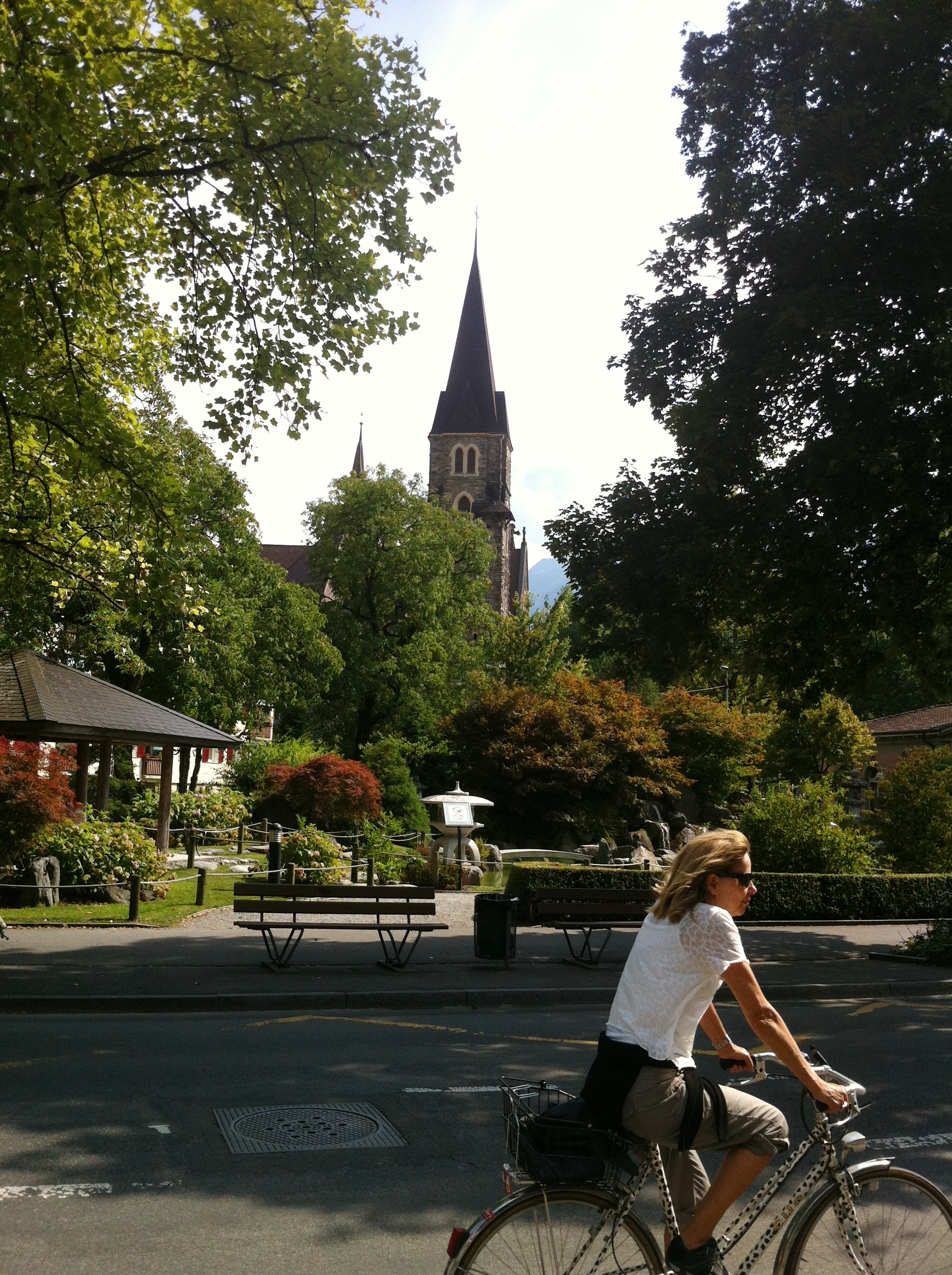
Biking in Interlaken

Biking in Interlaken

We are saying goodbye to Lake Como today as we travel by car to Lugano, Switzerland to catch a train to Interlaken, Switzerland.  The best part of the train ride is the home stretch on the tiny train into our destination.  The train advertised a scenic zoo along the way and indeed it was.  When we got to the slow mountain climbs through the forest, looking to the left and right at specific intervals, we would see a sculpture of some kind of creature. Bears, wolves, birds, anything indigenous to the area was revealed along the way. It was fun to keep our eyes peeled for the artwork placed along the rail route.  A great deal of work was put into the “ZOO.”

Arriving in Interlaken there are two train stations, east and west.  Getting off at the East Station you find yourself in the mist of luxury, turn of the century hotels. Walking along the Banhof Strasse there is a “high meadow” or park and here are beautiful flower gardens and the landing area for the tandem parasails. The end of the “high meadow” turns into crowded, very touristy shopping areas.  I was so shocked. I thought Interlaken would be a “Heidi” kind of place. It is over-run with tourists and it seems even the tourists own the restaurants and shops. Clearly Interlaken has been sold to the highest bidder and the Swiss have moved on. I am glad we have made this a springboard stop to other alpine areas. Reaching our destination, the Lotschberg Hotel & B&B, we find it is not run by a Swiss family, but has been turned over to caretakers.  Small and clean, the hotel was conveniently located in the old town area, but the only time we saw anyone here was when we would ring the bell at the check in area and eventually someone would come from one of the upper floors to see what we wanted.  The other disappointment was the lower level of the hotel had been turned into a kabab restaurant! So we were up and early everyday to go up the mountain! Maybe that was a blessing after all. We added more alpine villages to our itinerary, only returning to Interlaken at the end of a long day. It turned out perfectly.

THE SPECTACLED BEAN

Tales, Thoughts + Tribulations of a Free Spirit in Suburbia

Walking Away

Travels on foot

Teacher nickname: The Three Hairs

Minding my mind, one thought at a time.

Tra Italia e Finlandia

Un lungo racconto fotografico.

seanbreslin.jp

Photography, hiking, walking, and cycling across central Japan — from quiet mountain paths to everyday life around Nagoya.

Lost in Translation

Looking for meanings in words, images and sounds

Journeys with Johnbo

Reflections on places traveled and photos taken.

M/VGratitude

Cruising with the Thyrre Family

Caroline's Travel Adventure Blog

Where my Travels and my Blog merge together.

Just Me, Nobody Special

The mental meandering that cross my keyboard

Jennifer's Journal

Website & Blog of J. Kelland Perry, Author

Slow Shutter Speed

A photographic journey.

Ann Mackay: Inspired by Nature

Photography celebrating flowers, plants, and the natural world

Still Restlessjo

Roaming, at home and abroad

Fine for Friday

The Corner Garden

Picture This

Photography, Travel and Retirement

World Traveller 73

Upgrade Your Travels. First Class Luxury Travel from all parts of the Globe. Business Class Airline, Lounge and Hotel Reviews, Stories and Adventures

Rachel Meets China

A China travel and lifestyle blog